Wednesday, October 2, 2013

On week 4 of being a solo woman traveler

Two weeks ago I wrote about the downsides of traveling alone as a woman, about unsettling experiences with ill-intentioned strangers, and the darker side of people.

For my travel monthiversary I want to write about the joys and advantages of solo travel, about the wonderful people I've met along the way, and about how good this whole adventure has been for me.

A quiet, solitary moment on the road to Shangri-La

A few highlights


As I write this, I’m sitting in the back of a rental car with Ursula and Janine, a Swiss mother and daughter I met at a mountain lodge and who generously offered to let me join them on a side trip to Pucón, a volcanic region on my “want to go, but maybe too out of the way to be practical” list.

In my snowboard bag crammed in the back is mountaineering equipment—mountaineering boots, ice axe, and crampons—that belong to Sergio, the owner of the lodge I just left. When I told him my plans to climb Vulcán Villarcia, the volcano that guards Pucón, and asked for advice for where to rent equipment, he spent the next several hours with me setting me up with everything I needed (including his own personal pair of crampons), giving me advice, swapping stories, and making sure I would be careful (but also have fun).
Earlier that day I enjoyed a few hours of conversation and a trip to the local thermal baths with David, a recent grad from Munich spending a year traveling, skiing, and working in Chile.

The day before, I climbed Vulcán Llaima, which would not have been possible except for the group of Argentinians (Stephen, Pablo, Hubert, Karina, and Julián) who let me and David bum a ride to the volcano with them and with whom I spent two raucous evenings drinking wine.

The several days before that were spent in Conceptión visiting geobiology contact and very respected oceanographer Prof. Osvaldo Ulloa, who welcomed me like an old friend and made me feel at home in a city I had never been before. When I left, he made me promise to call him if I needed any help with anything and before I did made sure that his friendly lab group hooked me up with mountain contacts.

And last week was spent in a magical place called Shangri-La out of Las Trancas, near the Nevados de Chillán ski resort with Pipe, the brother of a colleague and his group of mountain guides and friends (Manu, Panchi, Ignacio, Maria, and others). From the moment I arrived at their cabin I was treated like one of the crew, part of the family.

The BackChillan family preparing for a tour in Shangri-La

Part of the family


Nearly everyone here has been incredibly generous, warm, open, and friendly. From the locals—all but a few of whom were strangers before I arrived—who have adopted, fed, housed, directed, and equipped me, given me travel tips and advice on everything from where to go to how to say “leave me alone, creepface”, and who have made me feel so at home here (Ignacio, Macarena, Fer, Coti, Ramón, nameless busdriver, the BackChillan crew, Osvaldo, Sergio, and others), to the fellow nomads with whom I have shared adventures, wine, and meals (Tom & Ellen, the good folks of the Princessa Insolente, the Argentines, and Ursula and others at Suizandina), I have been reminded every single day how lucky I am to be human. How wonderful it is to be part of a big family of organisms that, with very few exceptions, are good to each other, look out for each other, are kind to each other, who genuinely want to connect and share with each other.

Over and over again I think of this piece by comedian Patton Oswalt in the wake of the Boston Marathon bombing reminding all of us that, while there are creeps, assholes, and dickfaces, rapists, cannibals, and violent kidnappers, humans are defined not by our darkness but by our remarkable sense of “we’re in this togetherness”:

We would not be here if humanity were inherently evil. We'd have eaten ourselves alive long ago.”  -Patton Oswalt 

Traveling alone as a woman is special...in a good way


Here I am, alone in the world, the solo woman traveler. Yet I am not alone. Even when I’m alone in the mountains I am surrounded by my human family. I was absolutely right to take the leap of faith that I did and jump into this adventure, alone, trusting in the basic goodness of the people I would meet along the way to make this experience a good, rich, and largely safe one.

In fact, I have come to appreciate what so many other solo woman travelers have said before me: it is a great way to travel.

First, I am free! Free to let the wind blow me where I want to go. Free to join people on adventures or free to go my way alone. Free to go out at midnight and sing karaoke duets with the bartender in downtown Conceptión, or free to sit alone in my hostel room reading a book or editing photos. It is a deeply different experience than traveling with a companion. I have found that I honestly don’t miss conversation—I get plenty with the strangers along the way and those conversations are at least as interesting and less tired.

have felt moments of loneliness. But the people here have been so warm that those moments have been brief. And I am sharing my experiences, both with people I meet here and via contact with the people I love back home through emails, Facebook, and this blog. I feel just as connected as I ever did living as an anonymous face in the megalopolis that is Los Angeles.

I remember debating Chris McCandless's dying assertion that “happiness is only real when shared” once with an ex-boyfriend. I disagree with it: some of my deepest moments of joy have been when I've been completely, utterly alone, left to experience some bit of life's magic as the sole witness. There is something rich about standing alone on a mountain, feeling both small in the big beautiful world and deeply connected to it. Without needing to talk about it, argue the next steps, discuss dinner plans, hear what’s racing through the brain of a person standing with me, I am able to quietly soak in my experiences, and somehow more fully live them.

Sunset in Shangri-La, a quiet, breathtaking moment shared between me and the mountains


Advantages of traveling as a solo woman


Enjoying famous Chilean asado
with new friends in Shangri-La
Also, while a solo woman traveler may be, as Shannon at A Little Adrift puts it, the “lowest on the totem pole in terms of the types of travelers”, there are definite and valuable advantages. The exact traits that I described making me a target for creeps and harassment—my being a petite, friendly, clearly foreign woman—also make me a “target” for good people. I am absolutely non-threatening, so people—families, other women, strangers—trust me when they might not trust a man. My aloneness and young femaleness and foreignness makes people protective of me; people go out of their way to make sure I’m okay and taken care of. A bus driver might dump a guy off on the side of a deserted road at night without a second thought, but might wait around and make sure I have a safe ride to where I’m going. People are generous with me where they might not be as generous with a man. People take me under their wing because I seem small enough to fit there, even when they are fully aware that I can take care of myself.

Being alone also forces me and makes it easier to meet new people. While traveling as a couple, I’d end up in a private double room vs. in a shared dorm with potential new friends. I’d have dinner at a table for two, not ask a group of strangers if I could join them (or at least as often, get adopted into the “family” by a group of strangers). When traveling as a couple there were some very special and memorable times where my companion and I were invited in for dinner or drinks or a place to stay by strangers who took an interest in us, but where that happened maybe once for every month of travel as a couple. It happens to me almost every day here. It’s really cool.

How the experience has been shaping me


I am still cautious. Still deeply aware that even the well-intentioned can behave badly, still careful to avoid putting myself in situations that could turn dangerous, or even just uncomfortable and icky (e.g., no thank you, paunchy disco king on the bus, I appreciate the offer to cook me a very special dinner and drive me places but I think I’ll pass…and I’m going to go sit somewhere else, thanks). But the fear that defined me two weeks ago when I was crying in my locked hostel room is gone. I am still a sweet and petite gringa traveling the world all alone. But I am also a strong and competent adult knows who she is, what she wants, where she’s going, who has no patience for inappropriate attention, and who knows how to stand her ground and firmly say, “Dejamé en paz!” That fear has been replaced by a sense that I may be a stranger here but this is still my world. I feel able to face the unknown with confidence and with my heart open to the shining souls and walking treasure chests of experience and stories and humor of the good people that I have met along every step of this trip...and a willingness to deliver a swift kick to the nuts when warranted.

I am sure I will have more moments on this trip where I don’t feel so strong. But I am certain that those moments will become fewer and farther between now. I am loving, loving, this adventure. And, for the first time in years—maybe the first time since I first crawled down from the beloved mountains of my childhood—I feel like myself again: heart, body, and soul reunited again in Mountain Carie who, in reality, is Whole Carie.

The great big universe, as viewed from my home for the week spent with BackChillan in Shangri-La

Monday, September 30, 2013

Volcán Llaima

This post is dedicated to the four of you who swore for years you'd join me on this trip and ditched. Well guess what, your loss, suckas.

Beautiful Llaima. Also, check out the monkey puzzle (Arucaria) trees.

Meet Llaima (pronounced jai-ma). One of Chile's largest and most active volcanoes: "frequently erupting" with the last big blow in 2008 and known for "spectacular lava fountains" in Chile. It's also the prettiest volcano I have ever seen, and I fell in love her the minute I laid eyes on her from my bus to Malalcahuello. So of course the first thing I did when I arrived at the beautiful Swiss lodge (with cheap dorm beds, yay) I had planned to make my base camp for the week was to weasel my way into a ride to Llaima the next morning.

Me + splitboard in a truck caravan of Argentinians on an epic Chilean Volcano ski tour. Excellent day.

View of Chile's Sierra Nevada volcano from Llaima, with more Arucaria trees.

Confession: I didn't make it *all the way* to the top. But I did make it within a few 100 meters. Since my dad talked me out of bringing my crampons and ice axe on this trip and I wasn't able to rent or borrow any, I was not equipped to summit. If I had attempted to go any higher than I did it is unlikely that I'd have lived to tell the story. The guys with ice gear barely survived the experience. So I hope y'all will let me count it.

Growing up in the Ring of Fire I've seen my fair share of volcanoes. Llaima is the prettiest one I've ever seen. Llaima is Chilean for sexy bitch. Fact.

And she was both.

Llaima, sorry I didn't stick around for dinner, but you were smokin' love.

Like, literally smoking. Note the horizon at left and the steam coming off the top. This baby blew in 2008. Google Llaima. Lava everywhere. This is all pumice.

Climbed as high as I could with the splitboard. Definitely noticed when I had left the skirt and hit the cone, the climbing went from normal good hard effort to placing every step carefully: step, load the skins, shift weight, step, load, shift, step, load, shift, feeling my heart jump into my throat every time I felt a slip.
At the point where the guys who had given me a ride to the mountain roped up and put on crampons, I didn't think I could safely climb any more so I scootched my way to a pumice talus field, ditched the board, and started to hike.

Hiking is a generous term. I was attempting to walk up a pile of crushed pumice at a 45° angle, boots slipping at every second step. Still, I kept parallel with the guys until the talus mixed with melty ice and it became clear that the mountain wanted nothing more than to crumble down to the valley, sweeping me with it. I stopped, ate a cookie, took in the views, and made my best attempt at a careful descent, popping ibuprofen on the way to reassure my screaming old lady knees. Only casualty: a few new holes in my hands (and gloves) from the sharp pumice.

And then the snowboarding. Snow was icy, then crusty, then wet, but it was great.


Hell yes I did

Little to say, much to show. Enjoy! :)  (also more photos here)

Saturday, September 28, 2013

Concepción

I descended from the mountains with a single purpose: to fulfill my promise to Frank (my Ph.D. advisor) to visit Prof. Osvaldo Ulloa at the Universidad de Conceptión. I had been introduced to Osvaldo a month prior via an email in which I was introduced to a stranger as “Dr. Frantz” for the first time in my life, and had promised to get in touch as soon as I had definite plans for when I would be in the area.


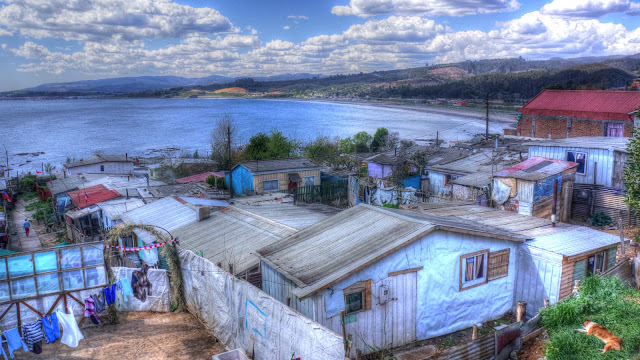
Boats in the harbor at Dichato. HDR.


People who know me and who have been following this blog have probably noticed that “planning” when it comes to travel is not my forte. “Impulsive” probably best describes my traveling (and life) style. I go where the wind blows me when passion strikes. Except sometimes; somewhere buried in my subconscious is a fastidious little German that has stuck around despite generations of dilution. The little German occasionally wakes up and freaks the hell out about the lack of a plan and then I spend an exhausting day researching, spreadsheeting, plotting, planning, and mapping until I know where I’ll be down to the hour for the next 15 years. But then, satisfied, the little German goes back into hibernation and the rest of me goes back to ignoring the plan.

The blowing with the wind is fine for me, but when it comes to interacting with other humans things get tricky. If I’m told to be somewhere on a certain day at a certain time, I almost always manage (within a 20-60 minute buffer), but in the absence of someone else planning my life for me, I usually don’t have plans past the immediate present.


Osvaldo = Good Geobio People


Anyhow, all that is to say that I contacted Osvaldo less than 24 hours before I would be arriving in Conceptión, having decided all of 2 minutes prior that it was time to move on from Chillán. Luckily by the time I arrived Conceptión, Osvaldo had responded that, yes, it would be fine if I randomly appeared at his office to meet with him.


I am so glad I did (Frank is always right, Frank is always right, Frank is always right).

Unexpected treat in Concepción: the full-buffet breakfast including juices and cereals and cold cuts and *cake* (the first time I'd had anything other than toast for breakfast all month) at my hostel.


I wandered around most of the Universidad de Conceptión campus, thoroughly lost despite having downloaded a google map to my Kindle and written down Osvaldo’s office information from the internet. But I finally found the building that matched the “new building” and Oceanography keywords that I was working with, told the receptionist who I was looking for, and was immensely relieved to find I had arrived in the correct place. As I waited for Osvaldo to return from an errand it occurred to me that I had only a very vague idea of what the person I was looking for looked like--from his university profile photo online. But when Osvaldo walked in the door, big smile on his face, I knew that he was the geobiologist I was looking for.


Concepción was hit hard by the 2010 earthquake. Nearby beach towns were devastated by the resulting tsunami.


Most of the geobiology people I know are good people, one of many reasons I love the field. Osvaldo threw the geobiologist bell curve in the “awesome and nice” direction. Within about 20 minutes of conversation, he had me seriously considering applying for a postdoc position with him, and that is a hell of a feat, given that I went on this trip in part to temporarily escape having to apply for postdoc positions.


Lota. One of the poorest towns in Chile, but you can't beat that view. HDR.

Frank always says that there are three key factors to consider when choosing a job: the people, the location, and the work itself. And, “You usually only get to choose one, so prioritize.” Something I find incredibly difficult because all of those things are deeply important to me. But the six years in L.A. (where I loved the work and adored the people) taught me that location is something I can’t compromise on. 

I inherited a deep need to be in the mountains from my mother, one of the other reasons for this trip: I went crazy in L.A. and I’m making up for missed mountain time. But Conceptión is only, like, a two hour bus ride from world-class snowy mountains. That’s like a bad day in traffic in L.A. The people seemed wonderful (Chilean + geobiologist was bound to be a winning combination). As for Conceptión itself, it’s a medium-sized city, a little rough around the edges and not particularly scenic, but the university campus itself is beautiful and there are stunning places very close by.

Now I just have to decide if the work is what I want; there’s a potential for it to be exactly what I’m looking for, but I need more information and time to think about it. Exciting regardless, and gives me hope that I actually may want to be employed again in the not-too-distant future.

I <3 Chile.


I began next morning by dropping off some laundry (clean laundry for the first time in a month!!) and buying some emergency clothes since all of my clothes were filthy and needed laundering. Then I headed off for my first excursion: the abandoned coal mine Chiflón del Diablo. Osvaldo had suggested it as an interesting day trip, and I was sold when he told me that the mine actually went out under the ocean. 

After an hour and a half local bus ride I arrived in Lota, one of the poorest towns in all of Chile, crushed by the evaporation of the coal mining industry that had previously barely supported it but attempting (somewhat successfully) to rebrand itself as a tourist destination. I followed signs through residential streets to the mine, hoping to find some of the area’s legendary seafood along the way. Alas, in the end I came up empty and had to be satisfied with a granola bar I had been smart enough to stash in my purse beforehand.


The miner's housing at el Chiflón del Diablo. HDR.


Immediately after paying the tour fee I was swept along with a very nice Chilean family also there for the tour by our guide. Our guide spoke broken English and occasionally translated a bit of what he was saying. Between translations, I desperately attempted to pick out words from what sounded like very interesting and dramatic stories he told to the family. 

The mine is famous for its inhumane working conditions, and there was an inescapable air of sadness inside. Our guide was terrific, and I really wish I had been able to understand him better, but in addition to his stories he had a very good photographic eye and took photos of us along the way. It was awkward: do you smile in pictures at a mine that crushed the lives of so many people? It felt a bit like taking selfies during a concentration camp tour. It was fascinating and I was very glad I went, but I was also very relieved to breathe fresh air once the two-hour tour was over.


At el Chiflón del Diablo. Do they count as selfies if someone else takes the photos?

I went out for beer that evening with Osvaldo and his lab group—a really fun bunch of folks. When I returned to my hotel I was still hungry, went in search of a quick snack (I had a hunger for empanadas). That explains how I ended up in a karaoke bar (they promised that they had empanadas). They didn’t have empanadas (liars!), they only had expensive appetizer platters, but by that point I felt famished and the free Pisco I was given at the door had kicked in and I ordered and ate the entire giant appetizer platter by myself. And then signed myself up to sing “House of the Rising Sun” since, hell, I was there, and obviously somebody needed to start the karaoke party. And then got talked into doing a duet of “Easy like Sunday Morning” (really? Haha) with the bartender. And then went home and crashed hard.

Osvaldo picked me up the following morning to go with him, his son, and a friend to a beach cleanup, which he had mentioned on my first visit with him and thought sounded like a nice way to see the area. What I didn’t know was that the beach cleanup was at the site of the old Marine Science lab, where Osvaldo used to have his lab and which was demolished during the 2010 tsunami. 

The battered shell of the marine research lab post-tsunami. HDR.


Driving through the town (Dichato) and hearing Osvaldo’s stories about the devastation, the homes destroyed, the businesses devoured, the corpses washed up on shore, was heartbreaking and surreal. But what really hit me was arriving at the research station, a place that reminded me so much of the Wrigley Center on Catalina Island or even more the Marine Biology Lab at Woods Hole, and seeing the ruins:

The half-standing lab benches. 
The sea tables with broken tiles.
The sun-rotted shelves that had once held bottles of media.
The pieces of a kelp mural on a crumbled wall.
The debris filling a basement that had once been a culturing facility but now looks like a scene out of a WWII movie, of a bombed shelter, chunks of concrete and metal making an ugly shell out of what had once been a home to world-class science.


Mural still visible on a remaining wall of the destroyed Marine Science lab at Dichato. HDR.


Unsurprisingly, two of the graduate students who had been at the lab when the tsunami hit were traumatized, one never returning and the other returning only after years in therapy. Just seeing the aftermath, three years later, was heart-wrenching.

The 20-some students who had arrived for the cleanup made quick work of the beach. They filled at least as many trash bags full of chunks of rebar, pieces of roof, and lab tiles as they did with the more typical Styrofoam, glass, and cigarette butts. Picking pieces of research lab out of the sand was a hard feeling.


Universidad de Conceptión Students at the Dichato beach cleanup. HDR.


After the cleanup, Osvaldo took me to see his home on the beach in a spectacular spot overlooking the ocean in a quiet village just outside Dichato. We had excellent seafood at a local restaurant as well as “cold tea” which is secret code for white wine, which the restaurants aren’t technically permitted to sell. A breathtaking part of the world, but the homes on stilts and tsunami warning signs were a constant reminder of the horror the region had so recently been through.


Boat on the beach of Dichato. HDR.


I returned to my hostel, stricken by the things I had seen during the two days in Conception, but also impressed by the resilience of people like Osvaldo who had to rebuild their lives (and labs) from scratch after the devastating earthquake and tsunami, and like the residents of Lota, rebuilding and reinventing their lives following the shutdown of the industry that once supported them. Respect.

The next morning I returned to my beloved mountains with a bug in my brain about the possibility for making Chile my home for more than traveling trip through planted.

More photos from Concepción in the Picasa album.