Showing posts with label geobiology. Show all posts

Saturday, April 26, 2014

The Atacama Part I

I have been to a lot of incredible places and had many unforgettable experiences on this South American Adventure of mine, but all great things must come to an end and the end of my trip has finally come. But not before one last big adventure.

Mountain Carie will argue this point, having had probably the most moving experience of my life while out trekking at the end of the world in November and, in February, having fallen madly, desperately, incurably, heartbreakingly in love with Antarctica, but Science Carie thinks that I saved the best adventure for last.

I spent three weeks in the Atacama Desert. The Atacama Desert. THE Desert of deserts. A desert stretching 100,000-130,000 km2 (depending on how it's defined), about the size of the entire state of Virginia, across northern Chile, Argentina, and southern Peru.

Marsscape in the Atacama


Sandwiched between the glittering beaches of the Pacific Ocean and some of the tallest, baddest mountains on the planet. Long considered the driest place on Earth (the ice-free McMurdo Dry Valleys of Antarctica are actually the driest, but I’m sort of reluctant to count anything in Antarctica as being on Earth). There are places in the Atacama where rain has never been recorded. And it’s been a desert for millions of years. The Atacama is peppered with active volcanoes, spewing geysers, immense salt flats, bizzare shallow lakes—some of the most extreme environments imaginable. It’s Mother Earth’s badass, mean, absolutely non-nurturing, stab-you-in-the-eye-socket-and-steal-your-lunch-money side.

It’s an astrobiologist's dream come true. It’s Mars on Earth.

It’s a place this geobiologist has dreamed of visiting ever since I first read a paper about how, although the soil in the direst parts of the Atacama are essentially sterile (unlike everywhere else on Earth) since life needs water and water is absent, there are cyanobacteria partying it up while buried inside salt crust fortresses which, because salt draws water, provides just the teeny amount of moisture sucked from the extremely low humidity in the air that lets life eek out an existence. Life living inside a salt crust. Because it’s more hospitable than the outside world. That, my friends, is badass.

Microbes chillin' in salt crust because, whatever, they like it there.

Getting there

Although technically I first entered the Atacama desert a month earlier en route to Peru, and was in her again while puking in the air over Nazca, I consider the start of this adventure to have been when I got off of a flight from Lima in the sketchy Peruvian border town of Tacna.

I had been dreading this part of my journey. Peru had me on edge ever since my welcome mugging in Lima. Up until Lima, I had led a largely charmed travel life, my experience reminding me that people everywhere are kindand nice and enjoy making human connections and are mostly to be trusted. That strangers are friends you haven’t met yet. My experiences with strangers in Peru were largely quite different. There were wonderful exceptions where I interacted with truly lovely, warm, interesting, good-hearted people. And I recognize that there are tragic reasons that things are the way they are in Peru. And I know my whole perception of the country and its people was soured by that first hour in Lima. But interacting with Peruvians felt like interacting with a bunch of ravenous thieves who would happily slit your throat in order to empty the contents of your pockets. It was stressful.

View from my hostel room in Lima


I still want to go back someday and give Peru a second chance, see more of some of the incredible landscapes there, eat more of the amazing food, and hopefully have more interactions with the Good People who I’m sure also inhabit the country. But this time a few weeks was enough. Being in Peru had me sleeping with one eye open and walking around with my hand on mypocket knife and it wore me out. So when I read warnings about how Tacna was a den of thieves and drug smugglers and that travelers should be on their guard at all times, I took the warnings seriously. And I wasn't thrilled that my travel plans for the day required:
  1. Getting a taxi from my hostel in a sketchy neighborhood in Lima (and horror stories about Lima taxi drivers abound) to the airport.
  2. A flight from Lima to Arequipa to Tacna (at least, I hoped, the flight would be reasonably safe? hopefully my neighbor isn't going to pick my pockets if I fall asleep?).
  3.  Getting a taxi (but don’t trust taxi drivers, who are liable to kidnap you) from the Tacna airport to the international bus terminal (a den of thieves, drug dealers, and other miscreants) on the other side of town.
  4. Finding a “collectivo” (= car full of strangers, hopefully ones who aren't thieves, drug-dealers, rapists, or others willing to slit your throat for a buck) ride across the Peruvian/Chilean border (entry point for narcotics smuggling, potentially dangerous), hopefully to the bus terminal in Arica, Chile.
  5. At the Arica bus terminal (bus terminals being, again, dens of thieves and drug dealers, with border-town bus terminals being the worst of the worst), hopefully getting a ticket for the overnight bus to San Pedro de Atacama, if not, I’d have to find a place to spend the night in Arica (and where?).
  6. If successful, entertaining myself in Arica, hopefully without getting mugged, until my 10pm bus departure (hanging around bus terminals late at night? Not safe).
  7. Taking an overnight bus (hopefully my busmates, again, aren't thieves or rapists) to San Pedro.
  8. Walking to my hostel, which does not show up on any maps and which I may or may not have a reservation for, in a town with no street names or addresses.

And as if all that wasn't enough, I woke up that morning running a high fever, with a splitting headache, horrible body aches, and a sinus cavity completely filled with mucus. I prayed for everything to please, please please please, go smoothly, and help me survive the next 26 hours, ideally with my luggage and virtue intact.

Miraculously, smoothly is exactly how everything went. My Lima hostel arranged a driver to the airport for me, and the pre-arranged price was fair and when he dropped me off he didn't demand anything extra (unlike how it works with every other taxi driver in the history of Peru). Check-in was painless. My closest neighbor on the flight was another young female tourist from Italy who was blissfully non-talkative, and we had a full empty seat between us. I was able to get a credential-carrying airport-licensed taxi driver to the Tacna bus terminal, again at a reasonable price, and he was friendly and gave me tips for how not to get taken advantage of at the bus terminal.

The Tacna bus terminal was a confusing shitshow and as soon as I arrived I was mobbed by hawkers of collectivo rides, all of whom seemed equally desperate and aggressive and sketchy, and was literally pulled around the terminal to pay various fines and fees that seemed questionable at best but I had no idea what the hell was going on. I ended up herded against my will and better judgment into a car with a rotund, handsy, and particularly aggressive Chilean driver.

Please, sir, I just want to go to San Pedro.


But it all worked out. He was completely crazy, but fun crazy. The nice older Chilean couple I was sandwiched between during the hour and a half ride across the border cracked jokes with me about how crazy the driver was while he loudly belted out one cheesy Peruvian love song after another between stops when he’d roll his window down and try to convince female pedestrians to come over and kiss him. The absolutely incredible part of these scenes was that they worked! Baldness, advanced age, and a shape approaching spherical must be to Chilean and Peruvian women what height, a rock-hard set of abs, and a shiny new Porsche is to women in the U.S.

Once safely delivered to the bus terminal in Arica, Chile (which, I’ll add, looked remarkably unshaken by the magnitude 8.2 earthquake that had hit Northern Chile just two weeks prior), I made a beeline for the Tur-Bus window to see about the availability of overnight bus tickets to San Pedro. I was in luck: there was one seat left, a window seat, which is what I always prefer. And there was a special deal going on so I got the seat for significantly less than the normal price.

Ticket in hand, I dropped my giant backpack off at luggage storage, walked across the street to a seedy but acceptable restaurant to get an early dinner. The way people smiled warmly at me when they walked into the restaurant made all of the stress I had been carrying start to melt off. I was back in Chile. Where people are nice to gringas. I managed to offend the hostess at the restaurant by not eating everything—I tried to explain that I was sick and my appetite was tiny, that the food was very good but I just couldn't eat all of it—but that is an unacceptable excuse in Chile. I had forgotten, back in Chile also meant needing to bring an appetite. But I think she forgave me by the time I left.

Back in the Arica bus station, it was every bit as sketchy as I had feared and I witnessed at least two drug deals, but my luggage was safely in storage and I had my bus ticket in hand. I sat down on a flight of stairs with my head in my hands and waited the final hours before my bus. I collected my bags at the last minute, hopped on the bus, and of all the miracles that day this was the best: my seatmate didn't show up. I had the row of seats to myself. Oh, blissful luxury! I sprawled out across the two seats and conked out. Slept like a champ the whole way to San Pedro.

I was gently woken up by a neighbor who alerted me that we were getting close, and wasn't it a pretty view! Then, once in San Pedro, a nice local woman offered to walk me the mile to the hostel, since it was close to her house. And when I arrived, the hostel hostess, who was sitting out in the dusty yard, greeted me by name. She had been expecting me. Apparently the reservation had gone through; she had just not had the internet connection to respond to my emails. I had a single room, set back away from the street toward the end of the long motel-like row of rooms set off of a dusty central yard strung with hammocks and buzzing with lazy flies. My little room, with mud brick walls painted white (except for one wall painted an oddly fitting shade of pastel orange), a rattan roof, linoleum floor, and a door that swam in its loose frame, a beat-up dresser missing a drawer, a ratty little nightstand, nails stuck as coat hooks into the cracks between the mud bricks, and a tiny little twin bed piled with a dozen thin blankets, all to myself. Relief washed over me like the rain the town was thirsty for. Finally, I could rest.

God bless Chile.

Cat, shredding the crap out of a pigeon it caught right outside my hostel room in San Pedro.

San Pedro de Atacama

Since I arrived with a fever and other trappings of the flu, I spent the first several days in San Pedro de Atacama resting, which consisted of sleeping anywhere from 9-12 hours, lying in bed doing python (the programming language) tutorials (yay! fun!), watching whatever TV or movies the ultra-slow internet connection at the hostel could manage to download, and occasionally walking the 10 minutes into town to get some food. I have so rarely rested on this trip that it felt glorious.

But I soon got antsy. I was in the Atacama desert after all, a place I had been dying to go for many years, and I was not content to sit in my hostel room and be a vegetable. So even though I was still a bit sick (but on the up and up!), I woke up one morning, made a PLAN (I am OCD about making PLANS), and then spent hours wandering around town trying to find the best deals for various activities.

My first order of business: the Tatio Geyser Field. This involved waking up at 3:45 am to catch a 4:00 am bus, which actually meant that I was so worried I was going to miss the bus (since, my phone having been stolen, I no longer had my normal alarm clock and was relying on my laptop to wake me which always makes me nervous) that I got up at 3 am and proceeded to wait for the bus until 4:50 am when it finally showed up. I am decidedly not a morning person, and require a minimum of 8 hours of sleep for full mental function (9 being closer to ideal), so needless to say I was a zombie: brain-dead, exceedingly grumpy, and hungry (but not for brains, having now actually tried brain, I consider it not a breakfast dish). I attempted to sleep during the hour and a half bus ride, and failed, but quickly started to wake up once we arrived and offloaded (and got some coffee and food in me) and I saw…

MICROBIAL MATS!! Wheeeeee!!!!

Me petting a nice, green, gooey, thermophilic mat.
Colorful thermophiles! <3


Not to mention the geysers spewing boiling arsenic-laden water everywhere. Unlike Yellowstone National Park (one of my favorite places on Earth, for many reasons), there were no boardwalks and eagle-eyed park rangers keeping people from crawling all over the geysers and dunking their hands in them (incredibly, nobody in our group fell through the crust and was boiled as tourist soup…something that unsurprisingly occasionally happens at Tatio), which meant that I got to pet all the microbial mats I wanted. I went from grumpy zombie to bubbly five year old within five minutes of arriving at what was essentially Disneyland for astrobiologists.

Once the sun rose (did I mention it was freezing? It was literally freezing. Cool to see the boiling water exit the geysers, flow downstream a bit, then freeze) and everyone snapped their tourist shots, I was reluctantly dragged away, but only because the guide promised me that if I liked bacteria, I’d love our next stop.

Beautiful steaming Tatio at sunrise

The Tatio geyserfield


Our next stop was a hot spring, full of things like brightly colored carotenoid-rich thermophiles and massive ropy streamers of greenish brown somethings and gooey slimy walls covered in, among other things, brilliant green cyanobacteria. And we got to swim in it. I had died and gone to heaven.

Swimming with the thermophiles
Colorful thermophilic phototrophs

The guide literally had to drag me away after that. Probably for the best, since my pale self wasn't holding up too well to the sun. The sun in the Atacama, especially at high altitudes like where we were (over 4300 meters = 14,100 feet) is no ordinary sun. The Atacama has been compared to the surface of the Earth prior to the development of an ozone layer 2.2 billion years ago due to the ultra-high UV flux that fries the Atacama because of its high latitude, extremely high altitude, and lack of cloud cover. Standing around in the high Atacama is like standing under a UV sterilizing lamp (not quite, but close…). Don’t tell my dermatologist I’m here, please.

I was exhausted from all of the day's excitement, but it was Easter, and I got talked into attending the Easter Saturday Night service (didn't know that was a thing) at San Pedro's historic church. Considering that I was raised in a Protestant family I have been to quite a few Catholic services in my life, but interestingly none of them in my native language, and this was no exception. The church was beautiful with its white adobe exterior and cactus wood ceiling, but the service was an exercise in endurance, beginning with a bonfire-side prayer at 10pm and going until shortly before 1am following lots of sitting-standing-sitting-standing, badly-sung hymns, a half-assed and rambling sermon, and the parading around of a shockingly campy plastic Overenthusiastic (considering he had just become zombified following his being nailed to a cross) Jesus. I thought the whole redeeming feature of Catholicism was their masterful pomp and ceremony and perfectly executed music, and this was a sort of disaster. It struck me how utterly non-spiritual the experience was for me when I've had so many beautiful spiritual experiences on this trip--all of them while outdoors and not around a crowd of halfheartedly worshiping humans. I thanked God when the whole thing was over and I could walk back to the hostel and sleep.

San Pedro's church


My next adventure was to go sandboarding. A group of about 20 of us met outside the office in town at 4pm, were handed boards, boots, and a bar of wax, and driven out to the sand dunes in the Valle de Muerte (Death Valley…and it looked quite a bit like California’s Death Valley). The handful of us who said yes to whether or not we had experience snowboarding in powder before were set loose without lessons to go hike the dunes, strap our boards on, and hit the sand. Having watched everyone who tried it quickly faceplant as I was first hiking up I expected to have a rough first few runs before getting the hang of it, but, except for having to wax the crap out of the board before every 10 second run, was very much like boarding in really wet, heavy snow. I quickly scoped out the one jump-like object on the dune, a big rock with a conveniently-placed sand ramp, and spent the rest of our time there amusing myself with that. After the first time I hit it, a guy approached me on my hike back up the dune and after complimenting me on my mad sandboarding skills, introduced himself as a mountain guide and asked  if I wanted to go get wine with him after he got back from his next volcano trip he was just leaving on. I perked up at “volcano trip”. The next guide asked me out to dinner. I was holding out for volcano trip.

Me, sandboarding.


Video of the whole group put together by the agency that took us out.
I'm in there at 3:04, 4:46, and 8:54.

Volcano trip didn't end up materializing (sorry dudes, no volcano, no date), but I did get to see more cool stuff. My next excursion, after a few more days of troubleshooting python, was a trip out to a series of hypersaline ponds (lagunas) in the Salar de Atacama, the large evaporitic basin rimmed by mountains at the edge of which San Pedro sits. The lagunas are fed in part by groundwater, in part by the little rain that sometimes falls in this, the driest non-polar desert. Although the swimming was fun (higher salt content than the Great Salt Lake, so even more floaty), the real highlight was scoping out some of the microbial mats and colonized gypsum crusts around the lagunas. One, Laguna Tebenquiche, had stromatolite-like gypsum domes colonized on the interior by a rainbow of photosynthetic organisms in the textbook orange-green-purple spectral stratification sequence. Living in salt, using it as a safe home in this terribly arid, high-radiation environment. As someone passionately in love with phototrophic bacteria and fascinated by extremophiles, it was the most beautiful thing Science Carie had ever seen. Another place where the guides had to drag me from the scene.

I later found the one paper that has been published on the endoliths I saw. Strangely, they claim to have found Bacteriochlorophyll e in the gypsum domes, which are only produced by the brown-colored green sulfur bacteria (my favorites), but green sulfur bacteria did not show up in their DNA sequences. Suspicious.

Desert crawler used to get to the Lagunas

Selfies on the Salar

Endoliths!!!! :-D Yay!


That night I went out to see the Atacama's legendary night skies on a tour with a Canadian astronomer who also had access to a bunch of nice telescopes that were pointed at Mars (if I squinted I could sort of imagine I could see the polar ice cap), Saturn with its rings, Jupiter with its layers and moons, and some star areas of interest. It was awesome.

Telescope.


My final Atacama excursion was sort of my spiritual goodbye to South America. I filled my backpack with water, some food, and my camping equipment, and wandered out into the desert. I had spent some time looking at Google Earth and talking to locals about the area and decided on where I wanted to go. My trip was cut short by a Calama-bound taxi driver who picked me up just as I was leaving town and gave me a free ride to where my planned path left the main road heading west a few miles out. He was really nice, and after he dropped me off I felt pleased that at least my Spanish had progressed enough in the eight months of travel that I could now have real conversations with the people I hitched rides with.

I surfed down a steep sand dune to get down from the plateau we had driven up to the desert floor below. At the bottom, the ground was a salt crust, and it made crunching sounds as I walked that reminded me of walking on ice-sheeted snow crusts, the sort of “whoompf” that makes my stomach auto-drop because it hails avalance conditions. Except instead of snow, which reforms over the course of seasons, this was rock, and while the occasional scant rain in the area no doubt re-dissolves and moves the salt around a bit each year, I realized that my footprints were not footprints in snow that would be gone with the next melt, and stepped carefully.

Salt. Salt salt salt.
Volcano and gypsum crusts.


I wound my way around a salty riverbed that crunched underfoot. The going was much easier than I had expected, so I was moving way too fast for my plan, which meant that I would soon enter the protected Valle de la Luna in which I knew I was not allowed to camp, so I turned 90 degrees and headed into the labyrinth of ravines that makes up the Cordillera de la Sal, spending the next hour picking my way slowly upward. Eventually I arrived at the top of the Cordillera and, walking along a ridgeline, found the perfect spot with a view of the Valle de la Luna and the two other Cordilleras. It was exposed to the wind, but the views were unbeatable. So I set up camp, which meant I laid my tent out on the ground as a tarp with my leaky sleeping mat (post-repair attempt #20) on top of it and my big fluffy sleeping bag on top of that, since chance of rain was exactly zero.

I snapped a bunch of photos and read a bit while watching the sun go slowly down. I got hungry, and pulled my dinner supplies out of my backpack, and that's when I noticed that my stove was missing from my mess kit. Given that dinner was supposed to consist of spaghetti and soup and all I had was dry noodles and powdered soup, no stove meant no dinner. Luckily I had brought lunch for two days, so I made myself an avocado sandwich and munched on half of a bell pepper while I wondered where my stove could possibly have run off to (I later found it in a grocery bag back at the hostel). The sun set behind the cliff that marked one end of the Valle de la Luna, and I curled up in my sleeping bag to watch the stars come up.

Sunset, as viewed from my Spot.

My spot.


But long before stars, it was the wind that came up: first a breeze and then a howl. I decided to move camp to a calmer spot out of the wind, and quickly before twilight gave way to the black of a moonless night in the desert. I found a spot down the hill a bit tucked into a shallow gully. The gully was narrower than my sleeping mat, so after laying down the tent again as a protective tarp over the sharp crystalline edges of gypsum that made up the gully's walls, I folded in my leaky mat and burrowed myself with sleeping bag into a sort of camping taco.It was surprisingly comfortable, but I couldn't sleep.

The high altitude, cloudless skies, and remoteness made for quite a night sky show. First came Jupiter and Saturn and Mars accompanied by a handful of other bright stars. Then, as the sky faded from gold to purple to black, I was able to spot Orion, the Southern Cross, the stars of the Zodiac, and then the Milky Way and Magellanic Clouds. The moon was below the horizon, but the sky seemed almost bright for starlight. I watched satellites race each other across the sky, saw several shooting stars, watched as Scorpio crawled its way slowly up from the horizon as Orion chased Leo below it. When I looked directly overhead such that the dark masses that marked the cliffs that were my home for the night disappeared, I could imagine that I was floating in space, spinning slowly as I watched the stars punctuating the blackness of the universe.

Stars starting to appear at twilight.


Our planet is quite a spaceship, and we are lucky to have it as it zooms at 67,000 miles per hour in circles around the giant, glowing nuclear fusion reactor that powers the machinery needed to maintain the activities of the spacefaring organisms that it houses. Our spaceship, the reactor it orbits, and unknown hundreds of thousands of other spaceships that range in size from too small for a human to ride (but fine for a microbe) to over 300 times the size of ours, are, in turn, zooming around in a massive collection of other power plants, many of which have attendant spacecraft as well, some of which may or may not have passengers we would recognize as living. We are all together as a group racing other groups of varying configurations and sizes outward, ever outward, from the heart of our universe where all matter began.

As someone who grew up wanting to be an astronaut (a dream that grew out of my elementary school dream of wanting to be a "scientific engineer at NASA," whatever that means but which, young Carie would be amazed and proud to know, is pretty damned close to what I actually am now), the thought struck me that getting into a little metal capsule to spin like a flea around the stunningly beautiful and brilliantly comfortable life-supporting spaceship that I'm already traveling on wasn't so much more exciting than what I'm already doing.

But wonder gave way to philosophical terror as it always does when I look too long at the stars and think too hard about how I am just a tiny and transient sack of water only 0.00021% as old as the universe. That as precious and amazing as this life I have is, it will be over soon, long before I have seen even a significant fraction of my own spaceship, let alone understood it, let alone seen, experienced, or understood the rest of our vast, vast, and mysterious universe. That everything I value and experience and want and am is only a flash of electrons being transferred among atoms in a particular configuration that allowed me, for a brief and wonderful moment, to exist. And that I, and everyone and everything I know and value except the universe itself, will cease to exist. According to the belief system I was raised in that's all okay because I posses an immortal soul that, when I die, will float up to some alternate existence that it supposedly came from, having grown in empathy and wisdom or at least amused itself for a time during its brief adventure on Earth.

It's a nice thought, but small comfort on a starry night.

Milky Way snapped from my sleeping bag on the Spaceship Earth.


Timelapse videos from the night camping in the desert
-----------------
More Atacama photos up on the Caridaway Album

Thursday, March 27, 2014

The Long Road North Part VI: Lima

Cool cliffside restaurant near where I stayed with Kathleen in Lima that Kathleen took me to see during an awesome impromptu walking Geology of Lima tour. That bridge? The gap there was formed because there was a dike made of a more easily-erodible material that we could trace up into the beach and up the cliffs on the other side of the road. Neato!

Lima Part I: a not-so-warm welcome

I arrived in Lima after over two weeks of travel, of which over one hundred hours were spent on long-haul buses, all the way from the southern toe of the continent in Ushuaia, Argentina (or, if you're really counting, from the Antarctic Peninsula following a two-day crossing of the Drake Passage by ship). I was exhausted. But I had booked it north in order to arrive in Lima in time to meet up with my friend from grad school, Kathleen, who was in town for two weeks teaching an Earth History course at the university. After all that travel I was very excited to see a familiar face again.

After gathering my bags from the hold of the bus that had just taken me the 49 hours across the Antiplano from Argentina to arrive there in Lima, I asked the woman at the information desk (who, in contrast to every information desk person in the whole of Argentina, was very friendly and helpful) how to get a bus to where my friend Kathleen was staying in the Lima neighborhood of Chorillos. She directed me to a bus station across the street from the main terminal, which served a brand-spanking-new Metropolitano bus line, saying it was very clean and safe. Sure enough, it was equivalent to a nice light rail line in some of the finer public transit systems of the U.S. I was beginning to think that all of the safety warnings for Lima were grossly exaggerated, or maybe relics from a wilder time past.

Lima. Looks like L.A.


The only problem was that “Chorillos” was not one of the stops on the train map, so I asked a businessman standing across from me if he knew which stop I should get off at. I showed him Kathleen’s instructions, and he lit up when he saw the name of the restaurant she said she was near: Los Hornos. Sure enough, after 20 some minutes, the bus pulled up at a station across the street from a Los Hornos restaurant, so I got off. Except it didn't seem right. I sat down inside the train stop to get my bearings and was surprised that the train stations had free public wifi, so I pulled out my phone, got a GPS signal, and got thoroughly confused. My phone couldn't find the address she had given me and insisted that the restaurant across the street was the only Los Hornos in Lima, but I knew I was not in Chorillos. I asked a passerby who confirmed that I was still several stops away from Chorillos, the end of the line station. So I hopped back on the train to the end of the line and tried again. This time my phone was able to bring up Kathleen’s address, and it looked like I had overshot the jump-off-point by two stations. Back on the bus, back off, and I checked my phone map one last time to make a mental map of where I needed to go. Five blocks down one street, jog one block left, then right and two blocks down.

I couldn't wait to get to food like this: famous Peruvian ceviche (I did get some later).


I started walking. The sun was shining and I felt optimistic and excited: excited to be in a new country, in a busy big city, excited that I’d be seeing a friend soon. I was all smiles as I walked. Kathleen had said the neighborhood was swanky, and I wondered at her definition of swanky. It looked like a seedier version of the seedier parts of East L.A., but hey, I’m in Peru! I grinned and laughed out loud as I walked past my fifth market stall with stripped, freshly-killed chickens hanging on hooks from ropes across the front. I scouted out the little stalls selling food, making mental notes of the gloriously inexpensive prices for the Menu del Días, intending to come back for lunch after dropping my stuff off at Kathleen’s place. I wondered if it had been five blocks yet, the busy market stalls made it hard to judge where streets actually were. I kept walking, and started to feel like I had gone too far, I didn't recognize the names of what street signs I could see. I decided to quickly pull out my phone and consult the GPS.

I had had my phone in my hand for less than two seconds when I felt the shove in the back and the hand grabbing at my phone. I stumbled, clenched my hand tighter, holding onto my phone like it was a lifeline, and spun around to face my attacker. It was a skinny guy in a white shirt, not much taller than me, yanking hard at my phone. I yelled at him. He grabbed my arm. I grabbed his arm with my free hand and started to claw at him, still yelling. I wanted to kick, but I couldn't, I was too weighed down and off-balance with stuff. Then he pushed me hard and I fell sideways to the pavement, and in the split second that my grip loosened as I started to fall, he yanked the phone out of my hand and sprinted away. I looked up, pinned on the sidewalk by my heavy backpack, and saw him run off. I yelled for help: there were people all around, but nobody did anything until he had run off.

Post-mugging: a little scuffed up, but fine (pretty sure the guy lost more skin in the scuffle than I did).


Two women slowly walked up to me as I tried to pick myself up. One helped me to my feet. She asked me what I was doing there, “It’s not safe here,” she said. No shit, I thought. They took me around the corner to a police officer, who chewed me out for being in the neighborhood. “This is the most dangerous street in Chorillos,” she said, “What are you doing here?” I tried to explain that I was trying to get to my friend’s house, but now I didn't have the address and I was too shaken to remember it. I was sure I was within a few blocks, but didn't know where. She pointed me down the road to the police station.

One of the women walked with me to the police station and explained to the officer at the front desk what had happened, then disappeared, leaving me there to fend for myself. The officer told me to wait in the back office for someone to come take my statement and file a report.

About half an hour later, another officer showed up. He introduced himself as the captain, smiling broadly. He asked what happened and I explained. He repeated the street officer’s chiding about how I should not be in this neighborhood. It’s dangerous, he said. When I explained that I didn't know that, I thought it was supposed to be safe, I was trying to get to my friend’s house, he asked for the address. I remembered bits of it, and when I mentioned part of the street name he got furious and demanded to know the name of my friend.
“It’s a center for narcotics, half of the drug deals in Chorillos happen on that street. Are you crazy? You can’t go there.”
Great, I thought.

He must have seen the look of, “well fuck, now what” on my face because he softened.
“Smile, pretty girl, it’s going to be okay,” then he reached out to stroke my back, “You’re safe now. You’re safe with me,” he said, and winked.
That did not make me feel better.
“Do I give my statement to you?” I asked, as I pushed myself away from him.
 “You want to give a statement?” the captain asked, surprised. Why the hell else would I be here? I thought. “Okay, I guess.” And he called in another officer.
After another wait while the other officer got his computer booted up, which apparently was a half hour long process, I was called over to give my statement.

Name.
“Carie? Like the song? Caaaaaaaaaa-rie, Caaaaaaaaaaaaa-rie,” the captain started to sing behind me.
Age.
“30? So young?”
Marital status.
“I’m single, too,” with another wink.
After I had given the statement and asked for a copy, the captain told me to sit down with him at his desk and excused the other officer. He then started to go through a slideshow of his photos, hikes to a waterfall, him with his shirt off in the waterfall, 
“Oh, have you ever seen a cock fight?” I was slightly relieved that he meant chickens, but the images were still disturbing. “How long are you in Peru?” he asked.
“Three weeks. I am visiting my friend,” I replied.
“My gringa, Peru is wonderful, you will see. Please don’t think it is all like this today. Peru is beautiful. I want to show you Peru.”
I thought he meant photos and I smiled politely.
“You come with me, and I will show you Peru. He grabbed my hand and pulled me to him. I mentally freaked out but didn’t know what to do. I was in a police station surrounded by police officers all of whom had guns in their pockets. I was lost. I needed help to get to Kathleen’s place. But this guy is a creep.
He whispered in my ear, “Come with me, I will show you many things.”
I jerked back and exclaimed that I thought I knew a way to track down the thief: my phone has anti-theft software installed and with a computer, we should be able track the phone. I figured that would get him to think about something other than seducing me, would maybe get me access to the internet to look up Kathleen’s address or somehow contact her and ask her to come rescue me, and maybe actually track the phone.

Pretty view from a bar in Lima at night, looking out towards Chorillos.


The ploy worked, and the captain called in the station’s tech guy. We spent the next hour and a half trying to figure out how to get my pone-tracking app to work to no avail, all the while the captain would come by periodically and put his hands on my shoulders and rub my back and check in. When he wasn’t looking, I tried to signal to the tech guy that I was seriously uncomfortable, help, but he gave me a clear, “dude’s the captain, ain’t nothing I can do about it” look in response. I was able to get to my email, though, and shot a “PLEASE COME GET ME!” email to Kathleen, and looked up her address.

I told the officers Kathleen’s address and said I needed to get there, but they ignored me. The captain was determined to keep me there as long as possible. He had more slideshows that I needed to see.
“You come with me. I will show you Peru. You will be safe with me. I am a police captain. Nobody will mess with you if you are with me. I have guns.” He pointed to the gun at his hip, then winked.
“My friend has waiting for me for hours. She is probably really worried. Please, I need to go to my friend,” I pleaded.
“I will take you to your friend, but only if you will visit me. VISIT ME.” He demanded. Right, because hanging out with you in the police station is exactly how I want to spend my time in Lima?
“Here?” I asked, trying to show just how little desire I had to come back to the police station ever again.
“Yes, you will visit me here. And then I will take you to see Peru. You will be safe.” He paused for dramatic effect, put his hands on my shoulders, and winked again. “El único que no será segura es tu corazón." (the only thing that won’t be safe is your heart) I looked it up later just to make sure I hadn't mistaken the unbelievably corny line. How he managed to get that one out with a straight face I will never know.
 “I need to go to my friend.” Maybe tears will work, I thought. They weren’t hard to conjure up, stressed as I was. My eyes started to water.
“VISIT ME!” he demanded, shaking me. I nodded, and the first tear fell.
 “Good. Nonono, don’t cry, wait here, I will get a car.”
I was terrified and thought about bolting, but didn’t know where to go. I had Kathleen’s address now, but I didn’t know where I was or how to get there. And running from a police station seemed like a good way to get arrested. But I also did not want to get in a vehicle with Creepy Captain. I was frozen, not knowing what to do. I hoped that he would at least get me to Kathleen’s place and that I’d be safe once I was there.

He returned, “20 minutes, there will be a car,” followed by more photo show-and-tell and stories about how Peru is unsafe but I would be Safe With Him, and I was starting to wonder after 20 mins had passed if there was a car or if I’d be stuck there forever with him when a new officer walked in.

Much to my relief, he had been assigned to drive me to Kathleen’s place. The captain escorted me, hand on my back to the door, demanding, “Visitarme! Visitarme! VISITARME!” He blocked my way out the door.

It reminded me of my bus nightmare, and I had a flashback to the movie scene with the creepy guy yelling at the girl he had locked in his basement: Obedéceme! Obedéceme! OBEDECAME!”

But I was almost a free woman, so I smiled and said, “Si,” and he let me pass, giving instructions to the driver that if a blonde girl (Kathleen) didn’t answer the door at the address he was not to let me out of the car, and was to return me to the police station. I worried about that, because I wasn’t sure Kathleen would be home, she had left instructions that one of the kids or housekeepers would be there to let me in, but decided not to explain that point until I was in the car and on the road.

The officer drove me the three minutes to Kathleen’s door, who happened to have just gotten back from her work at the university and was standing just inside the gate outside of the house when I arrived. I was insanely relieved. The police officer briefly questioned her and Marta, the housekeeper and, satisfied that I wasn’t being dropped off at a drug den, excused himself politely and left.

Wow, was I glad to see this person (and needed that beer)!


Lima Part II: Let's try this again...

Needless to say, I didn’t go back to the police station. Marta, however, later said that she saw police cars driving past the house several times that day, which was unusual, and she thought it was hilarious.

I was determined not to let the mugging get to me. Later that evening, Kathleen and I went out with the kids of the house to go check out some of the nicer parts of Lima: Barrancos, a funky and pretty little artsy (the kids said “hipster”) part of town, and we watched the sun set over the beach and got ceviche, which I was pumped about because I love ceviche and Peruvian ceviche is awesome. The next day we went to the beach (bringing nothing with us but our swimsuits and towels so that there was nothing to steal), which was one of Kathleen’s first escapes from what she called the “Princess Palace”. Turns out that the reason she thought the neighborhood was swanky and safe was that she never left the safety of the beautiful gated home surrounded by tall walls that she was staying in except under the escort of the family chauffeur. Our beach trip was a glorious dash for freedom. We had a few more unescorted adventures, including a trip out for some lunchtime exploring, another for evening beers, and a fascinating adventure when I tried to buy a plane ticket to Cusco and it involved taking questionable taxis around town trying to find a certain bank and then handing over a fat wad of cash at the bank to a series of mysterious numbers that had been dictated over the phone and that I had copied down on a scrap of paper, hoping all the while that I wasn’t just wiring money to some gangster and would actually get a ticket (I did).


Adventures in Peruvian banking. Pretty fancy system, pretty weird way to buy a plane ticket.


But the highlight of my few days visiting Kathleen in Lima was when she asked if I’d be willing to talk about microbial evolution in the earth science course she was teaching at the university. Would I be willing? To talk to a captive audience about, like, my very favorite thing? Ummmm, let me think for half a second… We laughed at each other one night when, although we had planned to “go out” and “have fun” that night, we instead stayed in and ate bland spaghetti while feverishly working on our talks for the morning, the funny part being that we wanted to be doing that, that that was more fun for us than “going out”, because SCIENCE! We nerd partied until the wee hours of morning.

I hadn’t gotten to talk about microbes in what felt like a really long time (almost a year), my thesis having morphed to be about stromatolites = rocks, and my South America Talk Tour being all about stromatolites. But although as my friend Vicky says it’s a terrible abusive relationship, my heart belongs to the microbes. Prepping my talk was an excellent excuse to read back through way too many fascinating papers about photosynthesis and microbial evolution, and it was wonderful.

Teaching microbial evolution in Kathleen's Earth Science class


Class the next morning was fun (for me at least, not sure about the students), we ate lunch, hung out and worked in her temporary office at the university, went out for a final beer, and the next morning after a stroll down the coast we were driven to the airport together. And the driver got in a car accident right under the exit sign for the airport. Luckily we were able to get another taxi from there, but it was one of those moments. We had lunch together at the airport before saying goodbye, Kathleen flying back to her shiny new job in Chicago, me off to Cusco.

Sign on the way to the airport. Kraps crackers! Can't stop eating Krap! Oh, and watch out, prematurely balding kid, there's a pedophilic cephalopod right behind you.

Our taxi got in a car accident right under the sign for the airport. Nice.


Kathleen, thanks for letting me visit, it was great to see you!


Wednesday, March 19, 2014

The Long Road North Part III: Córdoba

For my overnight journey to Córdoba, I was seated next to a well-dressed older woman who very much admired the fact that the water cooler had a plastic flower perched on top. I tried to sleep, but the TV blared loudly (horror movies, as usual) well into the night, until, looking around me at around 3am and confirming that everyone was at least trying to sleep, I went up and knocked on the driver partition and pleaded with the driver to shut off the sound. He seemed surprised that it was still on, and did. And then I finally slept. For 3 1/2 hours until the bus rolled into Córdoba a full hour early.

I had stopped in Córdoba to visit my friend Fernando, who is now a geologist on the faculty of the University of Córdoba but who was still a freshly-minted PhD when I met him in 2008 when we took the Geobiology Course together. Geobio friends are forever friends, and Fer was my best friend from that summer. Our staying in touch has been helped by the fact that we both share a tiny subfield as researchers of lacustrine stromatolites. Actually Fer shares some of the blame for getting me into stromatolites, since I had only barely heard of them before taking the Geobio course, and they were, like, his favorite thing. I had just finished my first year of grad school and knew nothing. Fernando, on the other hand, had the Dr. title in front of his name. So I was prepared to believe everything he said (and I still do).

A few fun photos from Geobio 2008

Fer & me working on final data analysis, or something serious, and I'm pretty sure I'm seated where I am so that I could easily turn around and make him help me figure things out.
Fer analyzing microarrays (remember those?) while I modeled the latest in labwear fashion.

We were a good team: I taught him how to pipette, he taught me how to rock hammer. The spirit of Geobiology.


A lot had happened since that summer course. Fer moved to Tennessee for a postdoc. I switched projects and passed my qualifying exams. Fer returned to Argentina and starred in a TV series (see videos below). I switched projects again and started working on stromatolites for realz. Fer got married. I graduated. We had so much to catch up about! So I was thrilled when, while sitting at the bus terminal cafe sipping coffee,  eating a medialuna, and working on my talk, Fer showed up and gave me a big hug.

TV special on Fernando and his High Andean stromatolites

Part I (unless you are a math nerd, skip to 4:44)


Part II, filmed since of the whole series that year, Fer's segment was the viewer favorite (mine, too)


So yeah, Fer is pretty awesome. And so I was excited about meeting his wife who, I assumed, must be amazing to have landed a guy like him. And she was.

Wendy answered the door when we got to their house and greeted me without any hint of a Tennessee accent (how, Wendy?) despite being Tennessee born and bred. After the three of us chatted a bit, Wendy announced that she was going for a run, which sounded like an excellent idea so I asked if I could tag along. She took me on a mini-tour of the neighborhood, and we ran along the banks of what was usually a nice riverside park but that day was mahem thanks to the unusual flooding of the river that not only jumped its banks but decided to take over some of the nearby streets as well. Meanwhile I peppered her with questions and was deeply impressed with her story: a smart, tough, independent, successful lawyer who had fallen in love and followed a guy to a different continent, arriving in a foreign country and culture without knowing the language, but adapting so quickly and thoroughly that she's now the relationship's social anchor and has carved out her ever-evolving niche doing contract work as her own boss, speaks fluent Spanish, and has been adopted into Fer's extended family. Fer even half complained, "She has more friends than me here!"
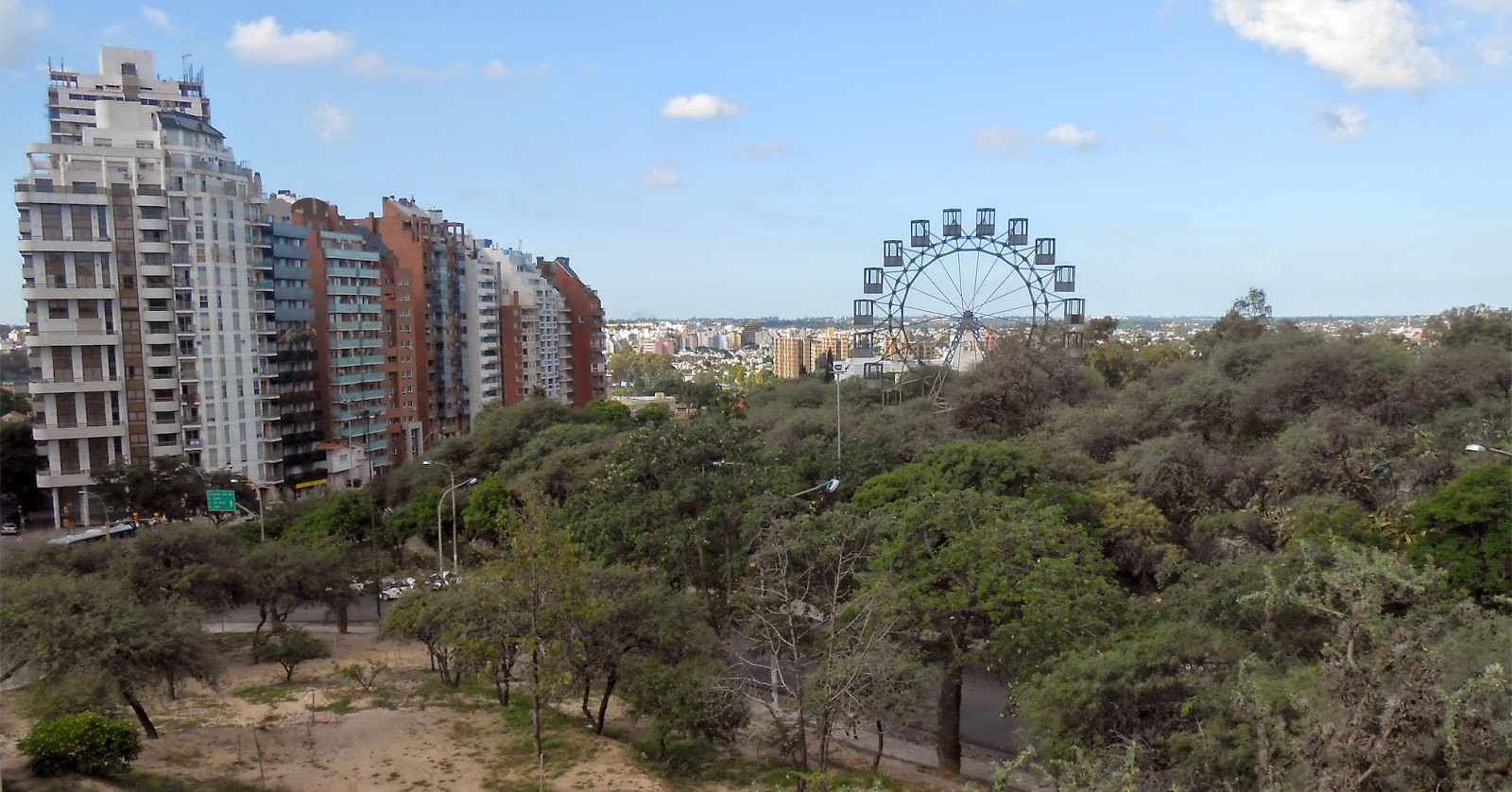
Ferris wheel in Cordoba designed in 1916 by Gustave Eiffel. Ironic, since George Ferris designed the original Wheel in 1983 for the Chicago World's Fair as an answer to Eiffel's Tower built for the the 1989 Paris Fair. There must be a story behind this...


I was doubly impressed because I know from experience how hard that is. In the end, I had not wanted to stay in Germany with my ex-fiancé. I spoke fluent German and had German friends and "family" even before I met him, but the culture and environment was too different, and it went beyond my capacity (and willingness) to adapt. I said I would have done it at the time, but I know it would have driven me nuts. I'm pretty sure I couldn't have lasted. It made me wonder if I could have done that under different circumstances, in a different culture, but a part of me doubted it. We are who we are and home is home and our culture is a part of that. And admired Wendy all the more for it. Home is also where your heart is, and where her heart was was obvious.

We returned to the house, and I showered and crawled straight into bed to catch up on the night of sleep I didn't get, and Fer and Wendy promised to wake me when it was time to eat. They didn't need to. My carnivore's nose pulled me right out of dreamland as soon as Fer fired up the Asado in their back yard. What followed was a feast: a giant slab of meat (and more meat) as well as grilled veggies that, I found out, had quite a story attached to them. Wendy may have arrived in Córdoba as a fish out of water, but she didn't waste any time in tracking down a laundry list of local farmers from whom she could reliably procure various families of organic veggies, like a sort of one-woman patchwork CSA. Now, years later, the whole system has gotten a bit more organized and she no longer has to go to 20 different farmers' homes to get 20 different types of vegetable, but she still puts the rest of us "yep. bring the box to my door. I can make it that far in my pajamas thanx" CSA-supporting veggiephiles to shame.

Was it delicious? What does it look like?? Of course it was.
And that's when the miracle occurred. My innate lunar cycle-timed capacity to lose a not-insignificant percentage of my body weight in uteral lining, apparently finally satisfied with the offerings of steak steak and more steak (and organic dark leafy green vegetables, too) that I had been plying it with all week, decided to return to me. It was a little, well, anemic, a [mercifully] far cry from its usual buckets-of-blood gory glory, but I was reassured me that my ovaries had, indeed, not been taken over by an alien or basketball-sized tumor. Iron. Turns out it's an essential mineral. If I had kept eating like I had been eating the past few months, the gnomes working in my bone marrow factories pumping out my red blood cells probably would have given up on the whole heme thing and would have started trying to substitute in manganese in hopes of producing chlorophylls instead. That could have been neat, but I don't know if I'd like life as a plant.

Anyhow, happily full of delicious food, and happy that my body had apparently started to return to normal functioning, I was ready to hit the town. Fer and Wendy took me on a brief driving tour of the city and then to a nice central park on a hill overlooking the city where we drank mate for a bit before continuing on to Córdoba's famous weekend artisanal market. The market, claimed to be Argentina's biggest, consists of a good several hundred stalls selling handmade jewelry of a thousand varieties, whimsically-painted pottery, mate gourds and bombillas in every imaginable shape, size, and design imaginable, books on the million medicinal applications of marijuana, the standard cheap trinkets you can find everywhere on this continent, giant chandeliers woven from sticks, antiques sold by Fer & Wendy's transvestite tailor neighbor, and everything in between. Meanwhile music drifted through the crowd from a group of enormously talented local kids performing on the street to a half-seated, half-dancing crowd.

Fer and Wendy as my designated Pathclearers for the Cordoba market.
Seen at the Cordoba Market. I'm a sucker for creative, artistic graffiti art.


Once we had had our fill of the market (Wendy bought a cute pair of handmade earrings), we settled into seats on a balcony overlooking the bustle from one of the hip resto-bars lining the market's street and drank some beers as the sun set.

The next morning I went with Fer to the university and gave Talk #2 in the Dr. Frantz and her Stromatolites South America Tour. I met Fer's academic extended family, from his PhD advisor to his current students and undergrads under his care. The excellent questions reassured me that I had made it mostly understandable. It was fun chatting with everyone and discussing the doubts that Fer's advisor had, which was good practice for the reviewer responses I needed to write up for the manuscript I had written on one of the topics I presented. He later hooked me up with tons of tips for my upcoming trip to the north of Argentina, including a field guide pointing out the location of a bunch of really nice stromatolites. Stromatolite people are good people.

Poster for the Cordoba talk
After lunch, Fer took me to the cafeteria for lunch and we reminisced about the Geobio course and how it had changed both of our lives. It certainly shaped mine. Life consists of a billion small and large decisions that subtly and dramatically alter the course our living takes. The Geobiology course was--and continues to be-- a giant magnet that pulled my life into its orbit and changed its direction in a huge way.

When I took the course, I had just finished my first year of grad school, a tough year where I spent a lot of nights sleeping in my office at the university while running all-night measurements and teaching early-morning classes on topics that I had previously known nothing about. I came to grad school with a background in engineering and a degree in chemistry. Yet the PhD project I had chosen was a pretty hardcore microbial metabolism study, and the department I was in was a geology department. I had never had a microbiology or geology class before in my life. It was a steep learning curve, and I felt like I was just barely keeping my head above water. The Geobiology course came highly recommended from  all of my mentors and I hoped that it would finally give me some background in the two subjects I was supposed to become an expert in--biology and geology. It did that, but more than that it made me fall absolutely in love with the field of geobiology, in love with the colorful and talented microorganisms that have shaped the chemistry of our planet since life's beginning, and introduced me to stromatolites, which years later would become the topic of my PhD thesis, despite spending most of my PhD working on bacterial metabolism. It also introduced me to the people who would later become my advisors, mentors, letter-of-recommendation-writers, and some of my closest friends.

More fun Geobio 2008 photos

Fer: "These are beautiful, domal, rounded, nicely formed stro..."
Richard: "Boobs?"
Fer, getting held up by a bird somewhere in Wyoming.
Will, 2008 course director, demonstrates the proper investigation of sensitive sites while Frank, current course director supervises.


In addition to the professional and academic impact, the course was a catalyst that changed my personal life as well. Being surrounded that first summer with smart, interesting, and largely well-adjusted people who liked and respected me was novel. I had spent the past three years in an intense and serious relationship with a smart, interesting, but not-so-well-adjusted boyfriend who regularly echoed the self-doubts in my own head that I was not smart enough, not good enough, not talented enough to be in grad school, to be a scientist. Who celebrated my successes by telling me that the only reason I was accepted to programs like my PhD program and the Geobiology course was because I was a girl and programs had quotas to fill. Who would yell at me for hours about how stupid I was when I would fail to do things The Right Way, like the time I hung a pot in our kitchen from The Wrong Hook and he took that as an opportunity to berate everything from my pot-hanging logic to my abilities as a scientist and my goodness as a person until I left the house crying to go sleep in my office again.

The course was a much-needed reprieve from that. The people there made me feel at ease, accepted, a valuable part of the team, even though I was one of the youngest students and knew nothing. The mix of students from very different backgrounds provided a valuable life lesson: none of us know everything, and in order to succeed, we need a good group of friends with talents and skills different than our own. That you don't have to be perfect or the smartest person in the room to contribute, as long as you leverage the skills and knowledge you do have. And the course reminded me that I had skills and I was smart enough. And that I didn't have to put up with the bullshit I was used to getting from my boyfriend.


Monster! Giant kinda adorable inflatable one in a modern art exhibit in Cordoba.

In retrospect, I should have shown him the door when I got back home at the end of the course. I had intended to. But like many abusive partners, he had a charming and a sweet side and was a master manipulator. When I laid out my grievances when I came home that summer and told him he needed to go, he cried and swore earnestly that he was sorry, that he had been wrong, and that he would change. I wanted to believe him, so I did. I loved him like a person loves a three-legged puppy. "It's not his fault he's a asshole sometimes, he's insecure and sort of autistic, he needs me, I can't leave him." He was my best friend, we had a house together, the relationship was a disaster but it felt comfortable. And when he was good he was wonderful: kind, caring, empathetic, devoted, romantic, and bend-over-backwards helpful. But when he was bad he was a monster. He swore the same things again and again and again for years more until I finally, finally pulled my shit together and closed the door for good. It took years and was one of the hardest things I've ever done, and things may have turned out a lot differently for me if not for the glimmer of hope for a different life that I saw during the Geobio course that made me ultimately refuse to accept a life with someone who called me stupid.

All of that flew through my head while chewing my lunch and thinking about how the Geobio course changed my life. And across from me was someone I will always be grateful to for the part he played in both recruiting me to the Cult of Stromatolites and for being a living reminder that it was possible for a man to be smart AND kind, respectful, secure, and handsome (seriously Wendy, you won the love lottery! but then, so did he!).

Cordoba is famous for, among other things (like being a crazy university party town), its pile of historic Jesuit churches and educational institutions.
Not Jesuit, but very pretty. Everything was plated in gold in this cathedral. After seeing this, all the beautiful cathedrals I saw in Germany don't seem quite so impressive.


I spent a few more days with Fer and Wendy. One day when Wendy didn't have to work in the afternoon, she took me on a tour of some of the more historic parts of Córdoba (and was my guardian angel when she helped me arrange bus tickets for my upcoming adventures, dollar exchanging, and a camera repair). The two of them also took me to their local 50-year-old Arabian restaurant (apparently there is a large middle eastern community in that part of Argentina--who knew?) where I ate brain for the first time in my life (it was surprisingly tasty). But not before first stopping off for a late-night desperate exchange at Wendy's dealer where pesos were slipped through a wrought-iron gate in exchange for a paper bag full of goods: arugula, squash, beans, and other organic CSA veggies. Being that close to fresh produce made me itchy.

Hummus and Brain: not your typical Argentine dinner.
And not your typical Argentine restaurant sign.


I was excited to head up to the Argentine high desert--something I had wanted to do ever since Fer had showed me photos way back in 2007 of the stromatolites at his field site up there--but sad to say goodbye to Fer and Wendy. Thanks you two for the hospitality and I hope to be back someday! (and come visit me, you promised! haha)

Dangerous drug paraphernalia from Wendy's shady back-alley dealer.