Showing posts with label near-death experiences. Show all posts

Saturday, November 15, 2014

John Muir Part II: Sleeping With Strangers

Continued from Part I: God's Country...

I had intended to make this a 3-part series, following logically from the three stretches between resupply points, originally planned as 3 weeks. However, this one day was so memorable, that I decided it should get its own post.

Standing on top of Muir Hut following the most memorable night of my trip.

Day 7: Dusy Basin to Muir Pass

11.9 miles
Dusy Basin (10800')
Low Point: Le Conte Canyon (8750')
End/High Point: Muir Pass (11955')

I gave my guardian angel food-delivering-across-a-huge-mountain-pass-sister a big squeeze goodbye, leaving her in the questionable hands of a frazzled hippie (or more accurately leaving him in hers), and wandered back down to Le Conte Canyon wearing fresh clothes she had picked up for me and with my pack full of resupplied food, bandaids, toilet paper, and a new SD card. Partway down the trail, the cold rain started back up, although it wasn't heavy...yet. I hurried down the hill, hoping to catch the Boy Scouts before they packed up camp and left, leaving the stuff I had stashed with them unprotected against marauding hikers and marmots. I found them steps from where I had left them huddled around a fire, getting a reluctant start to their morning as the rain dripped down through the trees.

Waving goodbye to Jeannie on my way back to the trail
after her successful resupply mission.


I had a second breakfast of oatmeal from the scouts' extra food, a rare hot breakfast and a real treat. Two guys showed up from the south, the first Northbounders any of us had seen except ourselves (me and the Boy Scouts), and hungrily eyed the fire while pretending to look over a map with shivering hands until it got awkward and we called them over to warm up. A fire is a welcome thing on a wet, frozen day. After some shared oatmeal and a brief chat, they took off, and their departure reminded me that I still had over 3000' and 8 miles to go to get up Muir Pass, and then several miles more down the other side before I'd get to the next spot where I could camp. Anxious to get moving despite, or rather because of the cold and the rain (I wasn't going to get less wet standing around getting dripped on, I figured...little did I know), I packed up and told the Boy Scouts--the closest things I had to friends on that trail--that I'd save them a campsite in the Evolution Basin on the other side of the pass if they didn't catch me well before then.

The drizzle turned into a heavy rain, the wind picked up, and the day got progressively colder. Little did I know, having not had access to a phone signal or The Everpresent Internets since I started my hike 7 days earlier, a massive storm was moving across California, and rangers were closing off access trails to the JMT because of the danger of extremely cold weather, flash floods, and all manner of not-goodness. All I knew was that it was raining, and that I felt very cold.

I hiked as fast as I could to try to keep myself warm, although I never did warm up that day. I hiked for miles and miles without breaking pace or stopping to rest or pausing to have a snack because stopping meant freezing. I climbed slowly up toward the pass and the wind got stronger and the temperature continued to drop, and I shivered as I walked, I couldn't feel my face or hands, but I couldn't stop. There was no warm sheltered place, stopping meant freezing. It was cold enough, and I was wet enough, and tired enough, and my stuff was soggy enough, that I was scared that stopping could mean freezing to death.

The whole time I prayed that my sister had made it over her pass before the storm that was drenching and freezing me hit her, "Hit me with whatever you've got, weather, but give Jeannie sun!" I yelled at the Asshole Sky at one point. I found out later that she had been suffering through it too, and by the time she finally made it out to her car with the old hippie, both of them were in tears.

Rock Monster on the trail. My last chance for shelter on the hike to Muir Pass.


I knew I had to make it to the top of the pass, because that was the first place where there was shelter to be found, the famous Muir Hut. I had no idea what to expect from the Muir Hut was, but it was mentioned in my guidebook and the handful of wet, frozen hikers coming down off of the pass assured me that if I could just make it to the hut, it would be dry. But 8 miles is interminable in miserable conditions. I'd ask hikers coming down, "How much farther?" and they'd look at me with pity and reply, "Not close. Sorry." For hour after wet, windy, frozen hour. My brand-new sister-delivered poncho refused to stay on me in the wind, no matter how I tried to tie or duct tape it to myself. Protecting my backpack from the rain proved an impossible task, and I only hoped that my sleeping bag was staying dry (or rather not getting more damp) inside its garbage sack inside. At one point, the poncho blew up and tangled itself around my neck and, unable to muster the energy to curse, I started to cry angry, scared, cold, tired tears. I fought the urge to rip it off (and likely strangle myself in the process) and somehow managed to untangle myself despite my completely numb hands and shaking limbs.

And I kept walking.

Dripping trail on the way to Muir Pass


And walking.
And walking, counting my steps to distract myself from how horrible I felt.
And walking.
And walking, making bets with myself how many more steps it would be until I got to the hut. It was always more steps than I guessed.
And walking.
And walking.
Because stopping meant death, I was fairly sure.

Maybe it didn't mean death. Maybe I could have wriggled my sleeping bag and bivvy out and crawled inside before it got totally drenched. Maybe an exposed night in the freezing rain wouldn't have killed me, even if it would have been the scariest, most miserable night of my life. Maybe someone hiking down would have helped me back down the mountain to the more sheltered canyon and a campfire. Maybe.

But I kept walking, because maybe wasn't an option. I knew that no matter how hard the wind blew or how cold I got, I'd make it to that damned hut. And after five stumbling, shivering, nonstop hours, I saw the hut. 500 steps, I told myself, you can make 500 steps. It was a lot more than 500 steps. But I made it. Staggered up to the door. Pushed my way inside.

Muir Hut: the tiny little pimple in the middle of that pass.


Inside, the round stone hut was cold, damp, and dripping. When my eyes adjusted to the dark, I saw two guys sitting together in a corner, steam boiling off of them. The Northbounders. After first eying me like the unwanted houseguest I was, they quickly felt sorry for a fellow frozen miserable hiker and helped me out of my soaked outerwear (I was too numb and shaking too hard to even get my backpack off), helped me get my dry change of clothes and sleeping bag out of my completely saturated pack, and made me a hot mug of coffee to help warm me up. The hot coffee changed everything, and I slowly started to feel my hands again, and slowly started to calm down, and the relief of being safe and with other people had me silly with exhausted gratitude.

They had decided to stay the night and wait out the storm, as had a Southbounder who was sitting quietly in the dark corner of the hut who I hadn't noticed at first. It was illegal to camp in Muir Hut, but we decided our circumstances were exceptional enough that John Muir would forgive us. I, for one, was done for the day. Or at least done until the storm stopped for long enough to let me dry out and get to a real camp. And sun and balmy Summer-in-California temperatures did not appear to be anywhere on the grey and dripping horizon. And I was glad I'd have company in that dark, dripping, isolated, cave-like hut.

Setting up camp inside Muir Hut

Once I warmed enough to function, I set to work trying to set up a means of protecting my sleeping bag from the vigorously dripping hut interior. Water was leaking in through the roof, running in streams down the sides and dripping at every stone step, and the humidity inside from the drippiness plus four soggy humans was approximately that of a Turkish bath. Damp + down are a bad combination in the cold, and I worried about the saturation state of my sleeping bag, and worried about staying warm through the night. The hut was drier and warmer than the outside, but still neither dry nor warm.

We cursed the blocked-off fireplace, not that there was anything around to burn. We napped, me curled up inside my bivvy sack with my poncho over my face to protect at least my top half from drips. We told stories and laughed. We helped dress each other's blisters and patch each other's torn gear. We made what hot food we could and drank hot tea, hot coffee, hot water, and when a Southbounder with a platypus full of bourbon stopped through, we drank that, too. There were some impressive people who trickled through as the afternoon progressed, but only a hardy handful. It seemed most people had decided to hunker down and try to wait out the storm. The Boy Scouts never showed up. I'd never see them again (I'm sure they survived the day, probably by staying put where I had left them, but I hope they made it through eventually!).

My attempt to make a dry space inside the hut.
When I woke up from my nap, everything was soaked.

By the time darkness fell, we were a group of five. The Northbounders, brothers Mike and Ash, had managed to suspend one of their tent flies from the interior walls of the hut such that we had a sort of indoor tarp protecting us from the drips, at least at the hut's center. We all made dinner, sharing goodies around (including my large bag of organic kale which my sister had left me with; this became a running joke and to this day kale reminds my hut friends of our night together). Khai, the Southbounder, set up his tent on a bench on one end of the hut. Mike, a special forces badass visibly antsy from the delay in his hiking plans, found the hut too dank and had a good winter tent, so opted to set up outside in the rain, which had let up slightly.

The rest of us slapped our Thermarests and sleeping bags down on a tarp in the center of the hut floor underneath the drip-protecting tent fly. As the night got colder and colder, and Khai's snoring and the howling wind got louder and louder and the water dripping from the tent fly edges crept ever inward, we all scooted closer and closer together. Which meant that I quickly became sandwiched between two strange men.

The tent fly that kept us sort of dry that night.

Under any other circumstance, being trapped in a cold, dark hut in the middle of nowhere with a group of strange men would have been uncomfortable and weird to say the least. On other backpacking trips, I've gone out of my way to avoid crossing paths with strangers. But that night I was enormously glad they were there. It never occurred to me to be uncomfortable. I was glad to be the person in the middle benefiting from body heat on both sides. It's okay to spoon with strangers when it's all in the name of surviving the night. Exhausted from the day, comforted by the warm human bodies around me, oddly soothed by the arrhythmic dripping and resonant snoring, I fell into a deep and much-needed sleep.

It's kind of astounding how the boundaries between complete strangers break down in situations like that, how everyone is stripped to being part of the same human family. For the 12 hours or so we were in the hut, all any of us cared about was staying warm and surviving the night. Once we were all convinced of our own survival, our second concern became making sure all of the other humans around us stayed warm and fed and hydrated and comfortable and happy. Except the brothers, none of us had met before that day. None of us had any reason to give half a shit about anyone else in that hut. Yet without discussion, without question, we shared what we had--our food, our cookware, our medical supplies, our limited water, our shelter-making gear, etc.--and worked together to make a cold, leaking, drippy hut a somewhat pleasant home for the night. We entered the hut unwelcome strangers, and left it a close-knit family. It was a miserable day followed by one of the most lovely and memorable human experiences of my life.

Four of five of the Muir Hut Family the following morning.

Continued in Part III: The Social Animal

Like the photos? There are more in the Photo Gallery, and more will be added every day as I sift through them all...there are a lot!

Tuesday, November 19, 2013

Navarino VI: Bushwhacking North

Part VI in the story of my 7-day solo trek on Isla Navarino, continued from Navarino Part V: Bahia Windhond or the day I stood naked at the end of the world. To start at the beginning or to see the full list of Navarino episodes, click here.

Some of the remnants of the snow patches around the tent after breakfast.
I woke up after sleeping for eleven hours feeling decidedly under the weather. I had a headache, sore throat, full sinuses, and felt absolutely exhausted. But I got up and opened the tent door to find patches of snow around the tent from the storm overnight.  I made myself a sad breakfast of runny oatmeal (next time: pack more oatmeal) mixed with trail mix and honey, packed my pack, and headed back along the shore of Lago Windhond toward the refugio.

Lago Windhond


I walked slowly along the lake, stopping often to empty my sinuses and observe and note the changes in the rocks along the shoreline, but still made it back to the refugio in three hours and change. It was cold, but I made a sort of lunch with crumbly packaged wheat pita bread (having exhausted my supply of the much tastier and more robust fresh Chilean flatbread), butter, and a mystery pate smear. The treat, however, was the garbonzo mash, and I ate half of what was left. The flavor, garlic, and salt was just what I was craving.

I was back on the trail by shortly after 3 pm after having left my name with the others in charcoal on a wall inside.

Signature


I turned on my MP3 player for the first time on the trip—which had miraculously also survived the swim in the Death Swamp three days prior—for an energy boost. This time I followed the trail (which was mostly intact and visible at the refugio) instead of going through the bog I had come in on. It felt good to be on a trail, knowing I’d finally make good time again. Even if “trail” meant largely sparsely-spaced sticks in a different peat bog with the occasional boot print from the guys who had come through several days prior to reassure me that I was on the right track. For a good hour, I was moving fast.

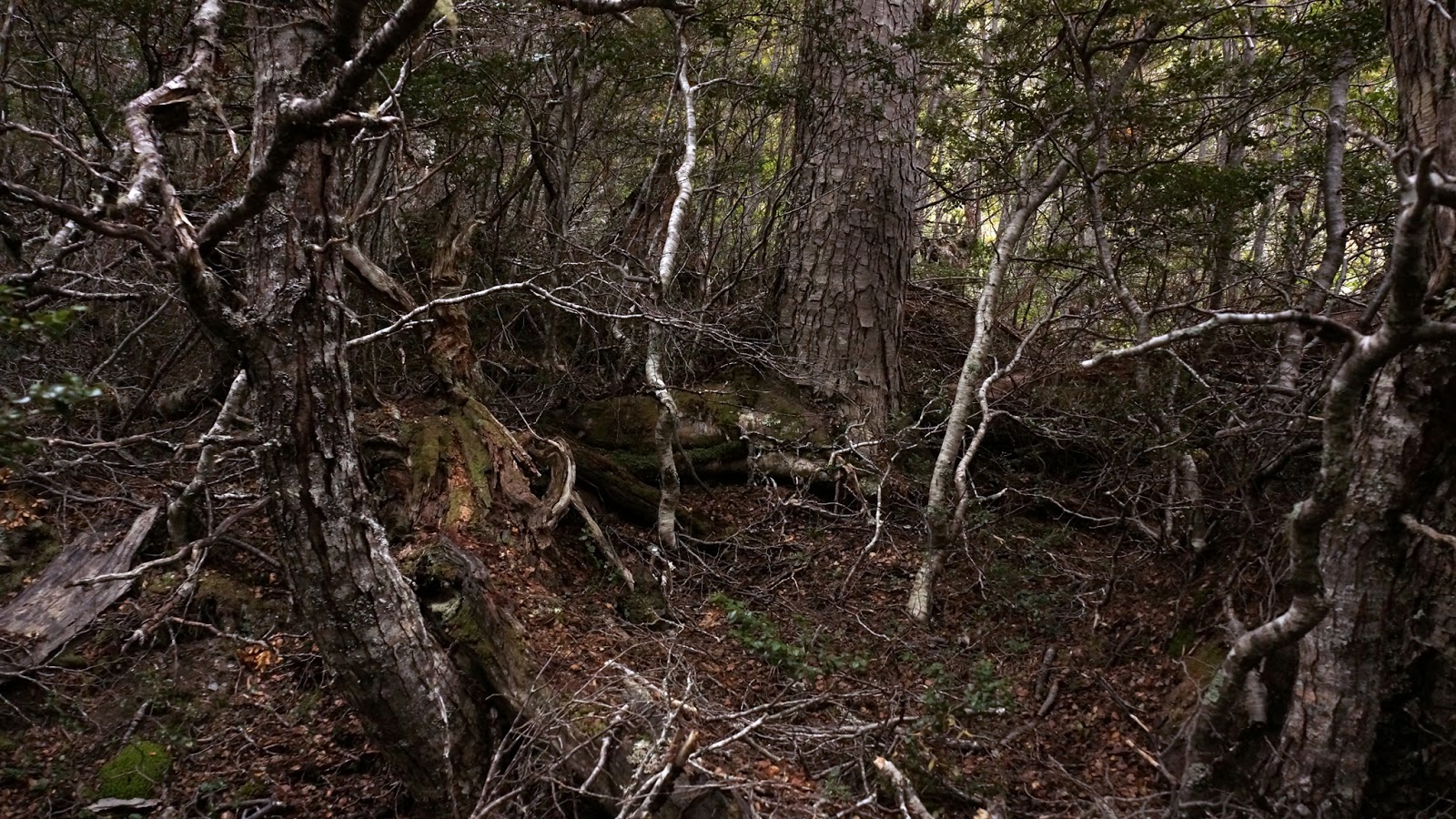
But beavers. Beavers, goddamned beavers, who once again were the bane of my existence having absconded with critical waymarkers in a confusing beaver-y area. After trying in vain to re-find the trail after crossing the beaver zone, I gave up and started to reluctantly climb the ridge the map said the trail climbed—the ridge I had avoided on my way down to the refugio three days earlier. The beavers and winter storms had turned the previously forested ridge into a labyrinth of fallen trees.

Domain of the Beavers


Here’s the thing about a labyrinth of fallen trees: it’s a jungle gym. And climbing a hill over logs, attempting to crawl under logs, balancing on slanted logs to climb over other fallen logs, shimmying up logs too slippery or narrow to confidently walk on—all with a pack—once again progress slowed to a literal crawl. What would have taken maybe 20 minutes with a good trail took over two hours of ducking under, crawling over, and falling into trees. 

It reminded me of a passage from Darwin’s Voyage of the Beagle, which I had been reading on my borrowed Kindle, about a side trip he made to climb Mount Tarn (on the coast south of Punta Arenas in Tierra del Fuego), just 200 km to the NE of where I was on Isla Navarino:

“We went in boat to the foot of the mountain (but unluckily not the best part), and then began our ascent. The Forest commences at the line of high-water mark, and during the first two hours I gave over all hopes of reaching the summit. So thick was the wood, that it was necessary to have constant recourse to the compass; for every landmark, though in a mountainous country, was completely shut out…So gloomy, cold, and wet was every part, that not even the fungi, mosses, or ferns could flourish…it was scarcely possible to crawl along, they were so completely barricaded by great mouldering trunks, which had fallen down in every direction. When passing over these natural bridges, one’s course was often arrested by sinking knee deep into the rotten wood; at other times, when attempting to lean against a firm tree, one was startled by finding a mass of decayed matter ready to fall at the slightest touch.”

The hill was muddy so even when I had ground (versus fallen trees) to walk on it was difficult. More than once I slipped and fell, each time grateful that the branches and sticks were just enough out of the way that one didn’t end up through my eye. After my fifth slip with branches alarmingly close to my face I became so certain that this climb was going to lose me an eyeball that I amused myself for the next hour of the following slog by trying to figure out how I would deal with the inevitable loss of an eye.

Would there be much blood? There are blood vessels in the eyelid, but to the eye? Could I just get by with sticking some gauze in my eyeball-less socket and call it a night? Maybe I could save the eyeball (assuming I could find it in the mess of logs and bushes and mud) and maybe it could even be rewired or something? But what if it was one of those blood-gushing injuries? Then I’d have to light a fire, get a stick glowing hot, and cauterize my own eye socket. That did not sound fun, but I mentally prepared myself for the possibility. At least it hadn’t rained since morning and there was relatively dry firewood around, so I probably could take care of business without having to move too far from where I fell. And once I cauterized my eye socket and made it back to civilization then I’d have to wear an eye patch because glass eyes look weird. And if I had to wear an eye patch then I should probably just go all out and dress like a pirate because people would be less weirded out by someone with an eye patch if they just imagined I was a pirate than they would be a normal person with an eye patch or a glass eye. Or definitely less weirded out than by a person with a puckered stick-cauterized vacant eye socket. And isn’t that a sad statement on our treatment of people with disabilities? And on my train of thought went.

It looked like this for hours.

Incredibly, I made it two hours later to the top of the ridge with both eyes intact, the only injury a puncture wound in my right hand. Better than having to cauterize my blood-gushing eye socket with a red-hot stick for sure. Sure enough, at the top of the ridge I found the trail again, although it looked like I wouldn’t have been much better off if I had found it at the bottom of the hill judging by the trees blown down in the “trail” at the less storm-affected ridge top.

By that time it was almost 7 pm so I started looking for a place to camp, especially since snow was starting to fall. No sooner had I found a spot and put up my tent than a full-on blizzard started, coating my tent in a two-inch blanket of snow as I tried in vain to start a fire for half an hour in order to melt snow for water. I shook the snow off the tent-turned-igloo, scooped it away from the zippers with my once-again-wet feet, and let my trusty camp cooker do the snow-melting job. I was trying to save gas with the fire, but oh well, I still had plenty of gas to last the final two nights, I hoped.

My campsite, just minutes after setting up the tent.


So I melted myself some snow and the resulting water was half sticks and leaves but tasted wonderful (and was clear vs. the weird red of the water the previous two days), and I even managed to cook myself a feast of multi-colored pasta with butter, my second package of tuna, some more mystery seasoning, and pumpkin soup again with the leftover water. All cooked by setting the stove outside in the snow and hiding in my tent, periodically thumping snow off the tent, reaching an arm out to check on the progress of the cooking, and retreating again for a few more minutes. The cooling of the gas can from the loss of gas while cooking caused the can to freeze solidly to the ground, and I was unable to pry it off of the ground, so left it in the snow overnight to deal with in the hopefully warmer morning.

Meanwhile, snuggled up in my sleeping bag, I planned a route for the morning. I decided to cut down to the valley I had just come from since with all this snow I didn’t think continuing on this trail up into the mountains was wise. I plugged my phone in to my spare battery bank to charge since it was getting low on juice and I might need the map and GPS on it. I was in the habit of keeping all of my electronics in my sleeping bag in order to keep the batteries warm and preserve their charge. Great idea in theory, but of course I promptly rolled over on the whole charging setup, broke the tip off the charger, and that was the end of that. No matter, I had managed to get the battery up to 70% first and had already plotted my GPS waypoints, so as long as I didn’t screw around with the phone too much in the coming days I figured I’d be okay. Still…dumb.


Then I settled in for my coldest night yet.

Snow sure is pretty though.

Continued in Part VII: Blizzards and Beavers

Friday, November 15, 2013

Navarino Part III: Paso de los Dientes and Descent into the Swamp

Part III in the story of my 7-day solo trek on Isla Navarino, continued from Part II: The hike begins. To start at the beginning or to see the full list of Navarino episodes, click here.

The night had been rough due to the wind and rain. 

I felt like I had been rained on all night since every time a drop of water would hit the tent in the right place hard enough (which was often), a tiny bit of spray would hit my face through the tent. I woke up at first light at 4:30 am to puddles of water inside the tent from condensation and a very damp sleeping bag (my most prized possession—my 0°F down sleeping bag—is wonderfully cozy and warm, but the minute it gets wet it becomes worthless as an insulating layer, so the damp bag was not just annoying, it was potentially dangerous). The inside walls of the tent were dripping wet and I spent a good twenty minutes sopping up the puddles with my little camp rag, wringing it out on the ground outside through the bottom zipper, soaking up more puddles, wringing out the rag, wiping down the walls, wringing out the rag, wiping down my sleeping bag and sleeping mat, wringing out the rag, and starting over in what felt like a hopeless case of bailing water out of my tent. Exhausted, discouraged, and frustrated, I went back to sleep. I woke again at 6 am, repeated the process, went back to sleep, and finally woke up for good at 8 am.

View from my campsite after Night 1


After another wipe-down of the tent, I cooked water for breakfast (oatmeal with generous scoops of honey, as well as some cookies and a half-moldy mandarin—you take what you can get in Puerto WIlliams), checking the water periodically through the bottom zipper. The sun came out briefly, cheering me up significantly and giving me a chance to partially dry out my soggy tent and sleeping bag while I made lunch (Chilean flatbread, which holds up well to a beating and tastes fabulous, some slices of packaged salami, smeared with butter and avocado) and studied my maps and trail guides. My goal that day was to cross over the Paso de los Dientes and head down a side trail to the north shore of Lago Windhond, some 13 km to the South as the crow flies. By the time I had eaten and packed and hit the trail, it was already 11 am.

The first snowfield, the tops of the peaks I'd skirt in a blizzard later in the day peaking out over the top.


The trail from the frozen lake climbed steeply up a creek bed at the north shore to a wide white bowl that was another frozen-over lake buried in a thick layer of snow. From the bowl of snow, the trail continued up a shallow snow-covered ridgeline. The sleet started almost as soon as I began the climb and turned to increasingly heavy snow as I continued, postholing through the deep, crusty snow all the way to the top of Paso de los Dientes, the first of the mountain passes of the Dientes circuit. By the time I arrived at the top of the pass, I was in the middle of a blizzard. Visibility was poor at best and there was no trail as any signs or cairns were buried in snow. But I can read a map and a compass and when I repeatedly ended up at places that, at least in the limited visibility looked like they were supposed to, I felt pretty confident that I was on track. Every once and a while after carefully picking my way across a steep snowfield that fell down into the end of my field of view or scrambling along slippery, rocky ridges I’d come onto an unburied cairn, confirming my choice of path.  However, due to the snow, the hike had taken a full three hours instead of the hour and a half I had been expecting.

Me in the Dientes in the sleet.


The views, I’m sure, would have been spectacular. I had heard that on a clear day from the pass you have stunning views of the mountains and ocean in all directions. As it was I could barely occasionally make out the outlines of the massive peaks that I was skirting.

It was still beautiful though.

I descended from the pass past more frozen alpine lakes and the snow turned back into rain and the cairns marking the trail gradually became visible again. I reached the turnoff for Lago Windhond (marked by a little arrow and LW spraypainted on a rock in a boulderfield). Scree gave way to peat at the end of the descent as I approached the beaver-dammed lake at the other side of the pass. In theory, there was a trail (I was in possession of a map showing a trail and even GPS waypoints all the way to the north end of the lake). But I kept losing the trail as the area was a maze of fallen logs and the beavers had run off with, it seemed, all the trail markers (which at this elevation were red stripes painted onto tree trunks). My GPS signal kept cutting out due to the heavy cloud cover, so was little help in finding the trail. Studying the map, I decided to continue straight on past the lake and through the bog instead of fighting through trees up ridges—the route the map showed—without a clear trail. At least in the swamp I could see where I was going.

Beaver damage along the shores of a lake south of the Paso de los Dientes


It was relatively good going along the side of the lake with the exception of some fighting through bushes until I got to the bog. It was like that scene in Lord of the Rings where Frodo and Sam and Gollum pick their way through the Dead Marshes, an absolute maze of soggy spongy ground snaking around eerie-looking holes (hereafter called the Death Swamp) that, I would soon find out, would happily pull you in and keep you there forever. I was soaking wet after the hike through the snow, and was not getting any drier slogging in the rain through the mushy bog, often slipping knee or even hip-deep into soft spots in the moss. It was like walking on a giant soaking wet sponge, complete with holes to fall into. Progress in the Death Swamp was extremely slow and, in the freezing rain, I started to lose my happy. And that was when I came across a line of water as far as I could see in either direction, too wide to jump across, even if it had been possible to get a running start in the moss. It was either attempt to hike around—wherever around was, which as far as I knew could be all the way back to the beginning of the bog—or choose my steps well and attempt to wade through.

Figuring I couldn’t possibly get any wetter at that point and may as well wade, I stepped…and immediately sank chest-deep into the muck.

The Death Swamp. Looks innocent enough in this photo, but beware!


My now waterlogged backpack rapidly became heavier as it started to fill with water and pushed me deeper into the mud, which seemed to have no bottom. I tried to stay calm, remembering horror stories from childhood about people struggling and drowning in quicksand because of their struggles and wondered if this could be similar as I tried to swim my way through the viscous goo to the other side. When I reached the bank, there was nothing solid to grab onto. Only sponge, and I was still chest-deep in mud with a heavy pack pinning me down.

After frantically smearing my hands around for a bit and realizing I wasn’t going to find anything to grab onto, I dug my arms as deep as I could into the moss on the bank to serve as anchors, and pulled on all of my climbing muscles to heave myself partly up so that my chest was on the bank and then, holding my chest up with my arms which were slipping out of the moss, I swung a leg up, and face and belly buried in the moss I wiggled, slowly, miserably, up out of the bog. It felt like ten minutes but in reality I was probably only in the water for less than 30 seconds. Still, it was more than long enough to get very, very wet, and enough to scare me. Dying in an avalanche while doing some epic splitboarding? Fine. Dying by hypothermia because I couldn't crawl my way out of a stinky hole in a swamp? Significantly less fine.

The hole that tried to eat me alive, trekking pole stuck partway in the mud inside for scale.


I threw off my drowned pack and unzipped my jacket as water poured out of it. My camera had been tucked away inside my jacket, and it had been submerged. My pockets, too, were full of water and I emptied those, wondering if any of my stuff: camera, cellphone that I had been using as my GPS, chargers, water treater, etc. would ever work again. I tried to dry things out as best I could by wiping them off with my undershirt, patches of which had managed to stay dry, but the patches were small and the rest of me was just as wet as the equipment, so I wasn’t able to do much good.

But mostly I was worried about my sleeping bag. Down bags are totally worthless when wet, and it was cold out, and if my sleeping bag was wet it was going to be a very rough night. As it turned out, however, the bag was fine. I had stored it in a plastic garbage bag and that had kept the water out of it. Same with my thermal camp clothes which I had also stashed inside a garbage bag inside my pack. My electronic stuff was maybe fried, but at least I’d be warm and dry that night.

Raindrops falling in pools in the forest. Photo taken while I was still un-miserable enough to enjoy the beauty of the rain...and while my camera was still working.


Shivering, sopping wet, hungry, and without a means of catching a GPS signal with soaked equipment and heavy cloud cover, I gave up on WIndhond and decided to head for the woods on the horizon in an attempt to find a somewhat sheltered, not-waterlogged, somewhat flat place to pitch my tent for the night. I walked as fast as I could (mostly to warm myself up) across the bog, focused on stepping on safe spots and praying for no more long uncrossable lines of mud. About an hour later, at around 6:30 pm, I made it to the woods. In the first semi-level spot I found big enough to set up my little tent I dropped my pack and attempted to build a fire, no easy task given the downpour and how hard I was shivering. Miraculously, I succeeded, and as the fire grew I hung my clothes and soggy boots on branches around it to try to dry them.

I was shaking hard from the cold, too hard to get my tent out of its bag. Remembering stories about the island’s natives who had preferred nudity to clothing because the place was always so damned wet and wet clothes are colder than bare skin, I stripped naked next to the fire. I felt immediately warmer. The natives were right, standing next to the fire with the rain falling on my bare skin, I was far warmer than I had been all day, and was able to stop shivering long enough to set up my tent.

Campsite. Yeah, camera wasn't working too well after its swim in the Death Swamp.


I could see steam coming off of my boots and clothes and hoped that the flux of water out of my clothes via steam was greater than the flux in by rain dripping in through the trees. Item by item as my stuff went from soaked to merely soggy, I tossed things into the tent. There’s nothing quite like snuggling with wet gear, but I didn’t want stuff to get any wetter.

As I arranged things in my tent I suddenly smelled smelly sock…smelly sock…SMELLYSOCK! I bolted out of the tent and saw one of my socks on fire. I snatched it and the other clothes items away from the fire, but it was too late for the socks. The toes of one had burned clean off, and there were large scorched holes in all the others. Shit. I had brought my only two pairs of good hiking socks, planning to switch them out each day and wear one pair while the other dried, and now both were burnt. I had brought one other pair of thinner socks, and although the thinner socks were much harder on my feet and I had meant them as dry camp socks, they would have to do.

My sad-looking campsite the following morning.


I didn’t even bother to cook dinner. I ate the rest of my open pack of cookies, my second sandwich that I had been too wet to eat before, and a few handfuls of cold Garbonzo mash instead. It was damp in the tent but at least I was out of the rain. My phone hadn’t died during the swim, but I still wasn’t getting a GPS signal. Still, after looking over the maps again I thought I had a pretty good idea of where I was and figured I was within an hour or two of the refugio that supposedly existed at the northern end of the lake. If I could make it to the refugio in the morning, I could hang out there and dry my stuff. Although I had heard that the place was infested with giant somethings—the Spanish word wasn’t one I had understood sounded like some sort of rodent but could be mosquitoes. Also, I had seen a few fresh-ish footprints of a group of three or so men on the way down from the pass earlier that day so it could be infested with humans as well. Being alone I was even less keen on seeing a group of unknown men than giant rats or mosquitoes. So as I curled up in my sleeping bag wearing every item of dry clothing I had (including, thankfully, my down jacket) I prayed for a dry day, at least a day without any more dunks in the Death Swamp, and that the refugio would be empty when I arrived.

Despite the wet, I fell asleep early and slept well that night, no doubt completely and utterly exhausted.

But I survived, and the story continues in better weather: Navarino Part IV: Refugio Charles and Lago Windhond